Planets & Deep Sky
Finding the Orion Nebula: A Beginner's First Deep-Sky Target
Learn how to find the Orion Nebula (M42) with your naked eye, binoculars, or telescope. A step-by-step star-hop for beginners.
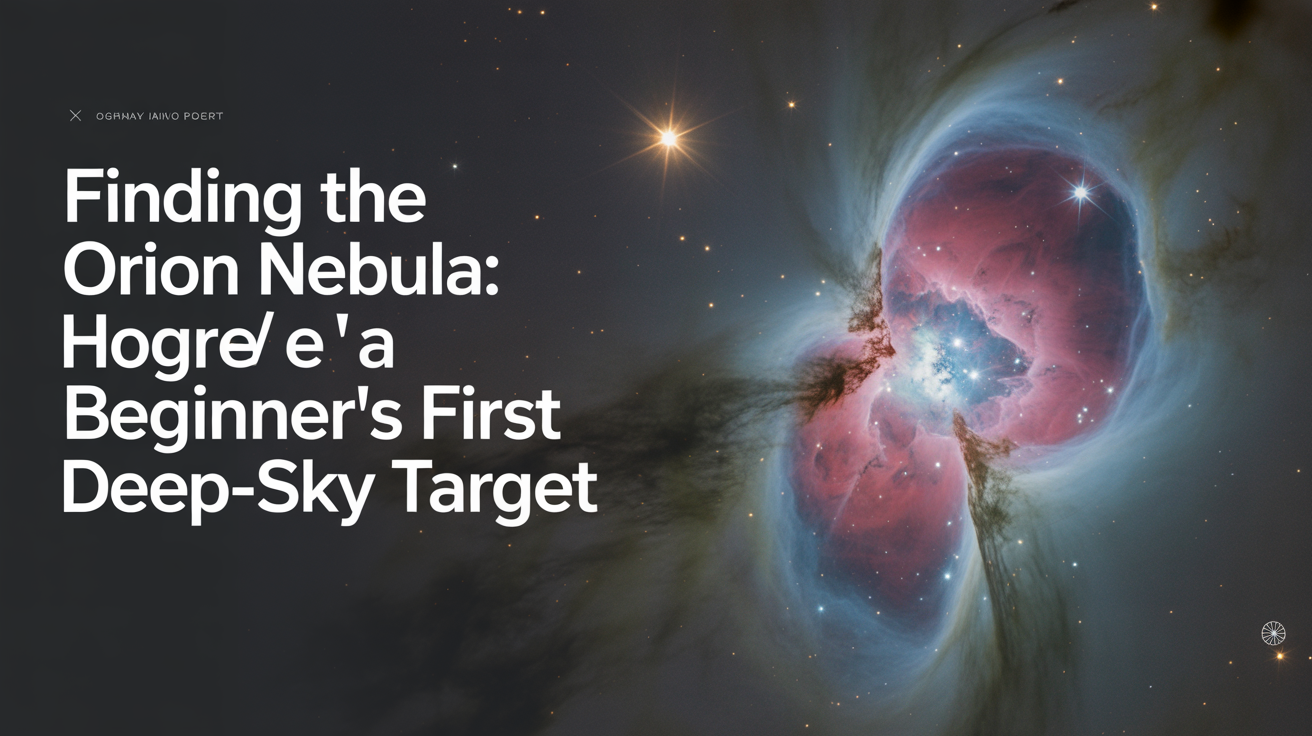
On a clear December night, step outside about an hour after sunset and look south. You'll see a bright constellation rising in the southeast, shaped like an hourglass with a distinctive row of three stars cutting across its middle. That's Orion, and hanging just below those three stars is one of the most rewarding objects in the entire night sky: the Orion Nebula, catalogued as M42.
It's visible without any optical aid from dark or suburban skies, glorious in a pair of binoculars, and genuinely breathtaking through even a small telescope. For anyone just getting started in astronomy, the M42 Orion Nebula is the single best first deep-sky target. Here's how to find it and what to expect when you do.
What You're Actually Looking At
The Orion Nebula is a stellar nursery, a vast cloud of gas and dust roughly 1,300 light-years from Earth where new stars are actively being born. It spans about 40 light-years across, which is why it appears so large in the sky despite the distance. At its core sit four young, hot stars called the Trapezium, whose intense ultraviolet radiation ionizes the surrounding gas and causes it to glow.
That glow is what you see: a soft, greenish-grey smudge to the naked eye that opens up into sweeping wings of luminosity through a telescope. The nebula sits in Orion's Sword, a short asterism that dangles from the Belt stars. The middle "star" in the Sword isn't a star at all — it's M42, and once you know that, you'll never look at Orion the same way again.
How to Find the Orion Nebula: A Step-by-Step Star-Hop
No star charts required for this one. Follow these steps on any clear winter evening.
Step 1: Find Orion
Orion is one of the most recognizable constellations in the sky. From the Northern Hemisphere, it's visible in the evening sky from roughly December through March, rising in the east after sunset and climbing high in the south by midnight in January.
Look for a bright reddish-orange star (Betelgeuse, the right shoulder) and a blue-white star (Rigel, the left foot). Between them, you'll see a rough rectangle of four stars with the Belt cutting horizontally across the middle.
Step 2: Identify the Three Belt Stars
The Belt is unmistakable: three equally bright, evenly spaced stars in a tight diagonal line. From left to right (west to east), they are Mintaka, Alnilam, and Alnitak. These stars are also useful for orientation when observing other targets, like Saturn's rings through a telescope or Jupiter's Galilean moons.
Step 3: Drop Down to the Sword
Below the Belt, look for a short, faint vertical line of three "stars" hanging downward. This is Orion's Sword. Under suburban skies you may only see two of them; under darker skies all three are obvious.
Step 4: Look for the Fuzzy Middle "Star"
The middle point of the Sword is M42. To the naked eye it appears as a slightly fuzzy, non-stellar patch. It doesn't twinkle the way stars do, and if the sky is even moderately dark, you may notice a pale glow surrounding it. That fuzziness is the nebula itself.
You've found the Orion Nebula.
Observing the Orion Nebula: What to Expect at Each Level
Naked Eye
Under suburban skies, M42 looks like a smudged star. Under darker country skies, you can see the core brighten noticeably and a faint glow extending outward. Even at this level it's distinctive once you know what to look for.
Binoculars
This is where the nebula starts to reward you. A standard 7x50 or 10x50 pair will show the Sword clearly, M42 as a bright core surrounded by a soft fan of light, and the beginnings of the nebula's wing structure. The Trapezium will appear as a tight knot of stars at the center. Spend a few minutes here. You're looking at a cloud of gas 24 light-years wide.
Small Telescope (60–80mm)
At 30–50x magnification, the structure becomes genuinely impressive. The nebula takes on a three-dimensional quality, with brighter and darker regions visible. Under good skies you may notice the Fish Mouth, a dark bay that cuts into the brightest part of the nebula from the north. The four Trapezium stars are usually easy to split at moderate power.
Larger Aperture (4-inch and up)
More aperture reveals more of the faint outer wings and subtler structure in the bright core. The sixth and sometimes seventh magnitude stars around the Trapezium become visible. Try magnifications between 40x and 100x; going too high actually dims extended objects like nebulae by spreading the light thin.
Tips for Getting the Most Out of the View
Use low power first. The nebula is large and needs a wide field of view. Start at your lowest magnification and work up only if the seeing (atmospheric steadiness) is good.
Let your eyes dark-adapt. Give yourself 15–20 minutes away from bright lights before observing. Dark-adapted eyes are dramatically more sensitive to faint detail.
Try averted vision. Instead of staring directly at the nebula, look slightly to the side of it. Your peripheral vision is more sensitive to faint light, and the outer wings of the nebula often pop into view this way.
No filter needed, but one helps under city skies. M42 is bright enough to observe from light-polluted suburbs without any filter. If you're battling significant orange skyglow, a narrowband UHC or OIII filter will suppress the background and increase contrast noticeably. Don't bother with a broad-band "light pollution" filter; the nebular lines these filters target are exactly what a UHC or OIII is designed to pass.
Compare it to the Moon. If you want a sense of how your eye and telescope perform on different object types, try observing the Moon's craters and maria the same night. The contrast between a sharp, bright lunar surface and the soft, diffuse glow of M42 is striking.
When Is the Orion Nebula Visible?
Orion rises in the east in mid-autumn (Northern Hemisphere) and sets in the west in late spring. The best evening viewing window is December through February, when Orion climbs high in the south during the first half of the night. In January, it reaches its highest point around midnight; in December, around 1 a.m.; in February, by about 10 p.m.
From the Southern Hemisphere, Orion appears in the north and is upside-down relative to the familiar northern view, but the Sword still hangs "below" the Belt (toward the horizon) and M42 is just as spectacular.
Observing the Orion Nebula is easiest when the constellation is at least 30 degrees above the horizon to minimize the blurring effect of atmosphere. Avoid nights when Orion is low and shimmering.
Frequently Asked Questions
Can I see the Orion Nebula from a city?
Yes. M42 is bright enough to be visible through binoculars even from moderately light-polluted suburbs. The fainter outer wings will be washed out, but the bright core and the Trapezium are accessible from almost anywhere. A UHC or OIII filter improves the view significantly under city skies.
What magnification should I use for M42?
Start low, around 30–50x in a telescope. This gives you a wide enough field to see the full extent of the nebula's wings. You can increase magnification to examine the Trapezium or bright core detail, but many observers find the nebula most visually satisfying at modest power.
Is the Orion Nebula the same as the Great Nebula in Orion?
Yes. "The Great Nebula in Orion," M42, and the Orion Nebula all refer to the same object. The M42 designation comes from Charles Messier's 18th-century catalogue of non-stellar objects. Technically M42 is the southern, brighter portion of the nebula complex; the fainter northern region is catalogued separately as M43, though visually they blend together.
How long does it take for the Orion Nebula to be visible each winter?
From most Northern Hemisphere locations, Orion is well-placed for evening viewing from around late November through mid-March. The "core" window, when Orion is high enough in the sky for good viewing in the evening hours, runs roughly December through February.
What else is near the Orion Nebula worth observing?
The area around Orion is one of the richest in the winter sky. Just north of the Belt is the Flame Nebula (NGC 2024) and the Horsehead Nebula, though the latter requires dark skies and a good filter to see. The double star Rigel makes a nice contrast target. And the entire constellation rewards sweeping slowly with binoculars on a clear night.