Planets & Deep Sky
How to Find the Andromeda Galaxy
Learn how to find the Andromeda Galaxy with naked eyes or binoculars. Step-by-step star-hopping guide, best timing, and what M31 really looks like.
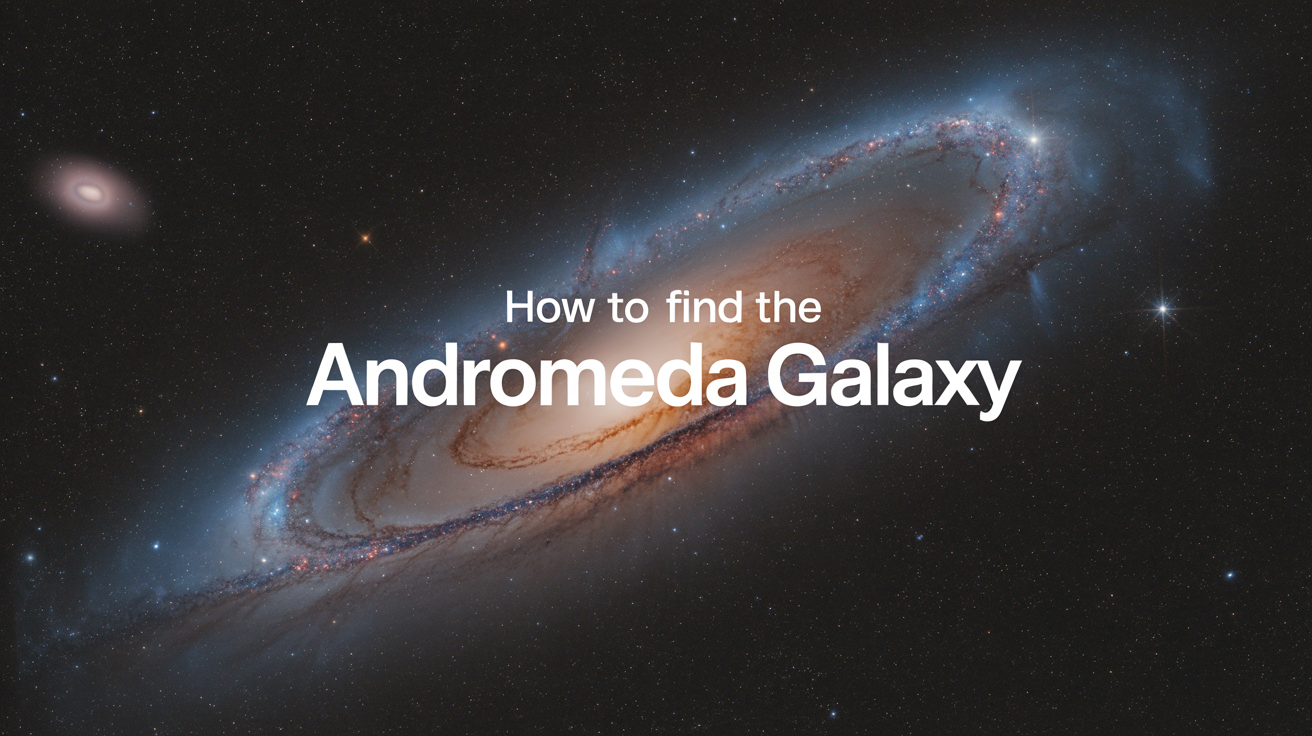
The Andromeda Galaxy (M31) is the farthest object a person can see without a telescope, and finding it for the first time takes about ten minutes once you know the route. Here is exactly how to locate it from your backyard.
What M31 Andromeda Actually Looks Like
Before you go outside, it helps to know what you are searching for. Seeing the Andromeda Galaxy is not the same as seeing a photograph of it.
In a typical suburban backyard under moderately dark skies, M31 appears as a soft, oval smudge of light, roughly two to three times the width of the full Moon but much fainter. There are no spiral arms, no obvious structure, no sharp edges. It simply looks like a gentle fog patch, slightly brighter at the center and fading outward.
From a genuinely dark rural site with no Moon in the sky, the glow becomes more obvious and can be spotted with the naked eye as a faint elongated blur. From a suburb or small city, you will almost certainly need binoculars to pull it out of the background glow.
Averted vision matters here. The center of your eye is best at color and detail but least sensitive to faint light. If you look slightly off to the side of where M31 should be rather than straight at it, the rod cells around the edge of your retina pick up the glow and the galaxy snaps into view. Try looking about five to ten degrees to the side of M31's position and let your peripheral vision do the work.
The companion galaxies M32 and M110 are sometimes visible in binoculars as tiny, round smudges close to M31's core, but on most suburban nights they are difficult.
How to Star-Hop to the Andromeda Galaxy
Star-hopping is the most reliable way to reach M31 because it works without any app or device once you learn the pattern. The route below takes you from a bright, recognizable landmark to M31 in four steps.
Step 1: Find the Great Square of Pegasus
In autumn evenings the Great Square of Pegasus dominates the southern and eastern sky from the Northern Hemisphere. It is a large, nearly perfect square made of four moderately bright stars, each about as bright as Polaris. If you are unsure which square it is, look for a region of sky that is notably empty inside the square boundary.
Step 2: Locate Alpheratz
The upper-left corner of the Great Square (when the Square is oriented so it looks like a baseball diamond) is a star called Alpheratz. Although it looks like it belongs to Pegasus, it is formally the first star in the constellation Andromeda. This is your starting point.
Step 3: Hop Along Andromeda's Chain
From Alpheratz, two curved arcs of stars extend away from the Square. The brighter arc, the one that curves slightly toward the northeast, leads you through two more stars:
- Mirach (Beta Andromedae): the second star along the chain from Alpheratz, a noticeably orange-red star and the brightest in the chain
- Mu Andromedae: a fainter star sitting about one binocular field north of Mirach
Step 4: Nudge North from Mu Andromedae
From Mu Andromedae, move your eyes or binoculars about one degree toward the northwest (roughly the width of two full Moons). The faint glow of M31 will be right there. At this point, use averted vision if nothing is visible yet.
A second approach that many observers prefer uses Cassiopeia instead. Find the W-shape of Cassiopeia high in the northeast sky. The middle star of the W, called Navi or Gamma Cassiopeiae, points roughly toward M31 when you extend an imaginary line from it toward the south. M31 sits about 15 degrees away in that direction.
| Landmark | What to Look For |
|---|---|
| Great Square of Pegasus | Large empty square in the south/southeast sky |
| Alpheratz | Upper-left corner of the Square; also the start of Andromeda's chain |
| Mirach | Brightest orange star in the chain, two hops from Alpheratz |
| Mu Andromedae | Faint star one hop north of Mirach |
| M31 | Faint oval glow about 1 degree northwest of Mu And |
Andromeda Through Binoculars and Telescope
Binoculars
Binoculars with 7x or 10x magnification and 50mm objectives are the most satisfying tool for M31 because they give you a wide enough field of view to see the full extent of the glow in context with surrounding stars. A pair of 7x50 or 10x50 binoculars will show the core as a brighter condensation at the center and the halo fading outward.
At this magnification you may also start to notice M32 nearby, which looks like a tiny round fuzzball very close to the bright core.
If you want to know more about choosing and using binoculars for planetary and deep-sky objects, the same techniques that apply to observing Jupiter and its four Galilean moons work well here too.
Telescope
A small telescope at low power, something in the 25x to 50x range, shows M31 about the same as binoculars but reveals more texture in the core. Higher magnifications do not help. In fact, pushing past 100x usually makes the galaxy harder to see because it spreads the light over more sky area, dropping the surface brightness below what your eye can detect against the background.
The best views through a telescope use the lowest-power eyepiece you own. For most beginner scopes that means a 25mm or 32mm eyepiece. The goal is to fit as much of the galaxy as possible into the field of view while keeping sky darkness around it.
One thing to note: unlike observing Saturn's rings through a telescope, which rewards higher magnification, M31 is a surface-brightness target. More power works against you.
Best Time and Conditions for Seeing the Andromeda Galaxy
Time of Year
M31 is circumpolar from latitudes north of about 41 degrees North but it transits highest in the sky during autumn. The best window for observers in the Northern Hemisphere runs from late August through November, with October being the peak month. During this period, Andromeda climbs to a useful height by 9 or 10 pm local time and stays high for several hours.
From late spring through midsummer, M31 is still in the sky but rises after midnight and stays low before morning twilight. It is observable but less convenient.
Moon Phase
The Moon is the biggest variable for faint-object observing. A full Moon floods the sky with scattered light and makes M31 invisible from suburban sites. Schedule your attempts for the five days before and after new Moon. The crescent and quarter phases can still work if M31 is well away from the Moon's position, but a full or gibbous Moon within 30 degrees of Andromeda will wash it out.
Dark Adaptation
Give your eyes at least 20 minutes in the dark before you expect to see faint objects. Red light preserves dark adaptation; white flashlights destroy it in seconds. This same principle applies whether you are hunting M31 or checking crater details on the Moon through a telescope. Astronomy apps can be set to red-night mode.
Light Pollution
From a Bortle 4 or darker sky (rural areas well away from city glow), M31 is visible to the naked eye once your eyes are adapted. From Bortle 6 to 7, typical for suburban locations, you will need binoculars. From Bortle 8 or 9, which covers most inner-city backyards, binoculars will still show the core but the outer halo will be invisible. Even then, the core is still worth finding. That faint smudge in the eyepiece is a galaxy containing roughly a trillion stars at a distance of 2.5 million light-years.
Frequently Asked Questions
Can I see the Andromeda Galaxy from a city? From a typical city, the sky background glow is bright enough to hide the outer halo of M31. Binoculars will still show the brighter central core as a small fuzz. You will not see the full extent of the galaxy, but the core is clearly non-stellar. The darker your site, the more you see.
Is M31 visible to the naked eye? Yes, under reasonably dark skies (Bortle 4 or better) and with fully dark-adapted eyes, M31 is visible as a faint oval smudge. It is one of only a handful of galaxies that can be seen without any optics. Do not expect the image to look like a photograph. It looks like a small patch of very faint milky glow.
What is the best time of night to look? Look when Andromeda is highest in the sky, which means waiting until it has cleared the horizon by at least 30 degrees. In autumn, this is typically between 9 pm and midnight local time, depending on your latitude. Trying to observe when M31 is low means you are looking through much more atmosphere, which dims and blurs faint objects significantly.
Will a bigger telescope show more? Somewhat, but not as dramatically as you might expect. A larger aperture (bigger mirror or lens) gathers more light and can reveal more of the outer halo and faint structure, but surface brightness stays roughly the same. The biggest improvement with any telescope comes from using a low-power wide-field eyepiece and observing from a darker site.
Why does the Andromeda Galaxy look different in photos? Long-exposure astrophotography stacks many exposures to reveal details that are far below the detection threshold of the human eye. The camera accumulates photons over minutes or hours; your eye only integrates light over about a tenth of a second. What you see visually, a soft oval glow, is real. What the camera reveals, sweeping spiral arms and dust lanes, is also real, just not visible without exposures measured in minutes.