Sky This Month
How to See the Northern Lights: Planning Your First Aurora Viewing
Learn how to see the northern lights with a beginner's checklist: KP index alerts, dark site tips, what direction to face, and how to photograph auroras.
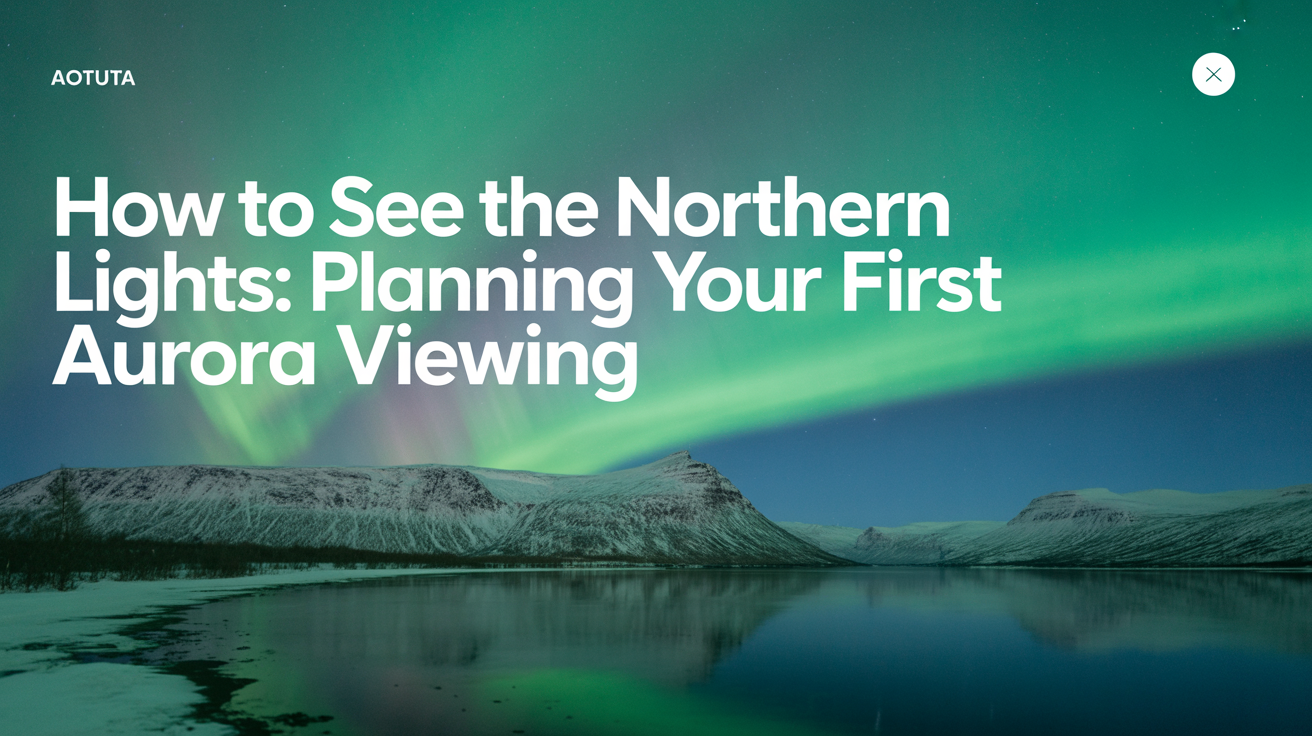
The northern lights are not just for Iceland or Alaska. With the right timing and a bit of preparation, observers across much of the continental United States, central Europe, and southern Canada can see auroras during active periods. This guide walks you through exactly how to plan a successful viewing.
What Causes Auroras and Why Mid-Latitudes Get a Chance
Auroras happen when charged particles from the Sun collide with gases in Earth's upper atmosphere. The Sun constantly streams particles in what is called the solar wind, but at certain moments it sends out far larger bursts. A solar flare or a coronal mass ejection (CME) can hurl billions of tons of magnetized plasma toward Earth. When that plasma reaches our planet's magnetosphere, it funnels toward the poles along magnetic field lines, exciting oxygen and nitrogen atoms that then release light.
Oxygen at about 100 km altitude glows green, the most common aurora color. Oxygen higher up, around 200 to 300 km, produces red. Nitrogen contributes blue and purple tones, though these are less common at mid-latitudes.
The reason mid-latitude observers can sometimes see auroras comes down to storm intensity. During quiet periods, the auroral oval (the ring around the geomagnetic pole where auroras are brightest) sits at high latitudes above 65 degrees or so. During strong geomagnetic storms, that oval expands southward. A major storm can push visible aurora down to 45 degrees latitude or even lower. We are currently near or at solar maximum, which means the Sun is at its most active phase in its roughly 11-year cycle. Active cycles bring more frequent and stronger geomagnetic storms, which in turn increases the number of nights when mid-latitude aurora is possible.
Understanding the KP Index: Your Main Forecasting Tool
The KP index is the single most useful number for aurora planning. It runs from 0 to 9 and measures the disturbance level of Earth's magnetic field globally. Higher numbers mean a stronger geomagnetic storm and a wider auroral oval.
Here is a rough guide to what each level means for observers in different locations:
| KP Level | Storm Level | Who Can See Aurora |
|---|---|---|
| 0 to 2 | Quiet | High Arctic only |
| 3 to 4 | Minor | Northern Canada, Scandinavia, Scotland |
| 5 | Moderate (G1) | Northern US border states, northern UK |
| 6 to 7 | Strong (G2-G3) | Mid-US, central Europe |
| 8 to 9 | Severe to Extreme (G4-G5) | Southern US, Mediterranean |
These are approximations. Local geography, horizon obstructions, and light pollution all affect what you actually see. But KP 5 or higher is the general threshold where people across, say, Minnesota, Washington state, or Yorkshire have a real shot.
Where to get alerts:
- SpaceWeatherLive (spaceweatherlive.com): Shows real-time KP and lets you set email or push notifications for KP thresholds you choose. The threshold graphs are easy to read.
- NOAA Space Weather Prediction Center (swpc.noaa.gov): The authoritative source. Check the 3-day forecast and the geomagnetic storm watches. When NOAA issues a G2 or higher watch, pay attention.
- Space Weather app (free): Gives push alerts on your phone; useful when you are away from a screen.
A KP alert tells you a storm is happening. It does not guarantee a sighting, because local weather, your horizon, and light pollution all factor in. But it is the trigger that tells you to go outside and look.
Finding a Dark Site and Knowing Where to Look
Light pollution is the second biggest obstacle after storm timing. From inside a city, even a strong aurora may look like a faint orange glow on the northern horizon and be dismissed as sky glow from another town. Getting out to a darker location makes a real difference.
You do not need a dedicated observatory-quality site. A rural road 30 to 60 km from the city center is often enough. Our guide to finding a dark sky site near you covers how to use light pollution maps and what to look for when scouting a location. The main practical point: face poleward. In the northern hemisphere, that means face north. Aurora activity starts at the northern horizon and, during strong storms, rises higher and spreads toward the zenith.
A few things to check at your site:
- Northern horizon clearance. Trees, hills, and buildings block low aurora. Find a spot with a clean view down to 10 degrees or less above the horizon to the north.
- Weather. Cloud cover kills an aurora session completely. Check a cloud-cover specific forecast like Clear Outside or Meteoblue, not just a general weather app. Planning around cloud cover is covered in detail here.
- Moon. A bright moon does reduce what you see, but unlike deep-sky observing, auroras are bright enough that a quarter moon or less is mostly fine.
Give your eyes at least 20 minutes to adjust to the dark before you decide whether you are seeing anything. Dark adaptation matters for aurora too: what looks like a faint whitish haze after 5 minutes of standing outside may reveal itself as a clear green band once your eyes have properly adjusted.
What to Realistically Expect
First-time viewers often arrive expecting curtains of green fire rippling across the sky. That does happen during major storms, but it is not the typical experience for most mid-latitude sightings.
More common at latitudes like the northern US or central Europe is a diffuse green or grey-green glow sitting low on the northern horizon. It may look like a far-off city's light dome, except it is north and there is no city there. During moderate storms (KP 5 to 6), you might see distinct rays or pillars rising from that band. During strong to severe storms (KP 7 to 9), activity can fill a large portion of the sky with moving arcs and coronas.
To the naked eye, auroras are often less colorful than photos suggest. The human eye's color-sensing cone cells need fairly bright light to activate. At aurora brightness levels, rods dominate, and rods are not good at distinguishing color. Green is the most commonly seen color because the oxygen emission at 100 km is the brightest, but reds and purples often do not register visually even when a camera captures them clearly.
Photographing Aurora with a Smartphone
A basic long-exposure phone shot will often show more color and structure than you can see directly. Modern iPhones and Android flagship phones have night modes that work well for aurora.
Simple setup:
- Put the phone on a tripod or prop it flat on a solid surface. Any movement during the exposure will blur the image.
- Open your camera and switch to Night Mode (or Pro/Manual mode on Android if you want control). Set ISO to 800 to 1600 and exposure to 4 to 10 seconds to start.
- Use a self-timer or volume button shutter so you do not shake the phone when triggering the shot.
- Point toward the brightest part of the display. Including some dark foreground (a treeline, a field fence) adds context.
- Review what the camera captured. If the photo shows a green band or pink glow where your eye sees nothing or very little, that is aurora.
Do not use flash. Flash will only illuminate the foreground and overpower any aurora in the frame.
The camera is also useful as a detection tool: if a storm is predicted but you cannot see anything obvious, take a test shot toward the north and check the result. Cameras regularly pick up displays that are genuinely below the visual threshold.
Frequently Asked Questions
How do I know when a geomagnetic storm is coming?
Set up a KP alert through SpaceWeatherLive or the NOAA Space Weather app. Choose a threshold that matches your latitude, typically KP 5 for the northern US or central Europe. When NOAA issues a G1 or higher watch or warning, check conditions at your location and, if skies are clear, drive to a dark northern horizon.
Can I see the northern lights from inside a city?
Occasionally, during very strong storms (KP 7 to 9), auroras visible from cities are reported. But light pollution washes out the fainter portions of the display. Even driving 30 to 40 km away from the urban core improves the view significantly, especially for the horizon-hugging glow that appears during moderate storms.
Does the northern lights appear every night near the poles?
Close to the auroral oval (Tromsø, Iceland, northern Alaska), auroras are visible on most clear nights. But from mid-latitudes, visible events are tied to active geomagnetic conditions. During solar maximum years, mid-latitude observers may get several good opportunities each season. During solar minimum, there may be none at all for a year or more.
Why does my camera show colors I cannot see?
Camera sensors are more sensitive to the wavelengths aurora emits and can accumulate light over several seconds of exposure. Your eye, in real time, is using mostly low-light rods rather than color-sensitive cones. The green oxygen line is usually visible to the naked eye during active displays, but reds and purples often require camera capture to appear.
What should I wear and bring?
Dress for the coldest version of the night. Standing outside for two or more hours in the dark is colder than it sounds, even in summer at high latitudes. Bring a head torch with a red-light mode to preserve dark adaptation, a warm drink, and a blanket or sleeping pad if you plan to lie back and watch. A simple app like Stellarium helps orient you to north if you are unfamiliar with a new location.