Getting Started
Dark Adaptation: How to Train Your Eyes to See More Stars
Learn how dark adaptation works, why it takes 20–30 minutes, and how to protect your night vision so you see far more stars.
Step outside on a clear night and look up immediately. You might catch a handful of bright stars. Wait half an hour without looking at anything bright, and the sky transforms. Thousands of stars appear where you saw dozens. That change isn't the sky getting better, it's your eyes finally doing their job.
Understanding dark adaptation is one of the most practical things you can learn as a beginner stargazer. It costs nothing, requires no equipment, and makes an enormous difference in what you can actually see.
At a Glance
- Cone cells (color, detail) adapt fast, in 5-10 minutes; rod cells (dim-light vision) take much longer and drive most of the gain.
- Meaningful dark adaptation takes 20-30 minutes; the process keeps improving toward the 40-to-60-minute mark.
- A single glance at a white light, including a phone screen, can undo 20-30 minutes of adaptation in seconds.
- Red light barely affects the rod pigment rhodopsin, which is why astronomers use dim red flashlights instead of white ones.
- Fatigue, alcohol, smoking, and low blood sugar measurably reduce how well your rods perform, even under a perfect sky.
- Once adapted, averted vision, looking slightly to the side of a faint target, uses your most sensitive rod cells and can make a borderline object visible.
What Happens Inside Your Eye
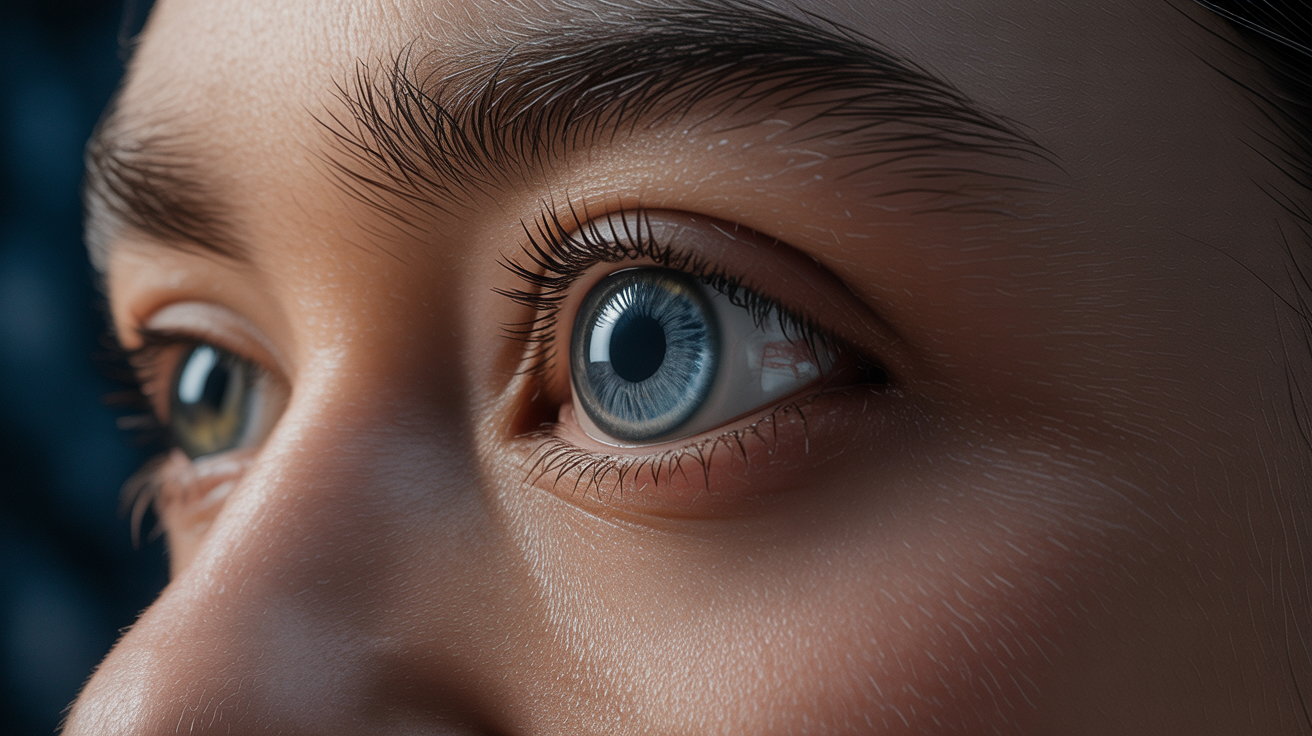
Your retina has two types of photoreceptors: cones and rods. Cones cluster at the center of your vision and handle color and fine detail in bright light. Rods are packed around the edges of your retina and are extraordinarily sensitive to dim light, but they're chemically slow.
When you walk into the dark, your pupils dilate within seconds. That part is fast. But the rods depend on a molecule called rhodopsin (sometimes called "visual purple") that bleaches out in bright light and has to regenerate chemically in the dark. That regeneration takes time. A lot of it.
According to the vision-science reference Webvision, cone-driven sensitivity levels off after roughly 5-10 minutes in the dark, at which point the slower rod pathway takes over and continues improving for a long stretch afterward, with sensitivity approaching its practical floor only after about 40 minutes. This two-stage curve, a fast cone plateau followed by a much slower rod climb, is sometimes called the Duplicity Theory of vision, since two separate photoreceptor systems are handing off the job as light drops.
During the first 5-10 minutes in the dark, your cones contribute most of your vision, reaching their own maximum sensitivity in roughly that same window. Then rod sensitivity starts to climb, taking a further 30-45 minutes to fully adapt. By 20-30 minutes, you have roughly 1,000 times more light sensitivity than you did under room lighting, and the fully dark-adapted eye can end up somewhere between 10,000 and a million times more sensitive than it was in daylight. Full dark adaptation, where rhodopsin is as fully regenerated as it can get, takes closer to 45 minutes to an hour, and some improvement continues beyond that.
For beginning stargazers, simply waiting out those first 30 minutes before judging the sky makes a dramatic difference. Many people give up on a perfectly good observing site because they only gave their eyes five minutes.
How Long Does Dark Adaptation Actually Take?
The short answer: plan for at least 30 minutes before your eyes are genuinely useful for faint objects. An hour is better.
The frustrating part is how easily it resets. One glance at a phone screen, a passing car's headlights, or someone else's white flashlight can destroy 20-30 minutes of adaptation in seconds. Rhodopsin bleaches fast; it rebuilds slowly. Bleaching even a modest fraction of the rhodopsin in your rods raises your visual threshold dramatically, far more than the same amount of bleaching does in cone pigment, which is part of why rods are so much more vulnerable to a stray flash of light than your daytime color vision ever is.
This asymmetry is worth taking seriously. If you're trying to split a faint double star or trace a dim constellation, a single unguarded moment of bright light sends you back to square one. Protecting those 30 minutes of chemistry is the whole game.
One thing that catches people off guard: fatigue, alcohol, and smoking all genuinely reduce how well your rods work. A tired observer under a great sky will see less than a rested one under the same sky. Staying hydrated and eating something before a session also helps, low blood sugar affects retinal performance in measurable ways. These aren't myths.
Adaptation Timeline at a Glance
| Time in the dark | What's happening | What you can expect to see |
|---|---|---|
| 0-5 minutes | Pupils dilate; cones still dominate | Brightest stars and planets only |
| 5-10 minutes | Cone sensitivity plateaus; rods begin taking over | Fainter stars start appearing; Milky Way hints at structure |
| 10-20 minutes | Rod sensitivity climbing steadily | Milky Way band becomes visible from a dark site |
| 20-30 minutes | Roughly 1,000x more sensitive than indoor lighting | Most faint stars and larger deep-sky objects visible |
| 40-60 minutes | Approaching practical maximum sensitivity | Best possible faint-object and averted-vision performance |
Why Astronomers Use Red Light
Red light has a long wavelength that barely affects rhodopsin. Rods are much less sensitive to red than to white or blue-white light, so a dim red flashlight lets you read a chart or adjust an eyepiece without significantly resetting your adaptation.
This is the practical answer to "why red light astronomy", it's not tradition or superstition. The photochemistry is real. That said, the red light still has to be dim. A bright red headlamp will still set you back. The goal is the minimum brightness you need to do the task, in red.
A few practical notes on red light sources:
- A cheap red LED flashlight works fine. Bicycle tail lights, filtered white lights, and dedicated astronomy flashlights all do the job.
- Phone screens can be set to red night mode (on both Android and iOS), but even at minimum brightness they're often too bright. Use them sparingly or cover with red cellophane.
- If someone in your group uses white light without warning, face away immediately and close your eyes for a few seconds. It won't fully save you, but it helps.
You can read more about what's visible with the naked eye once your night vision is properly built up, the list is longer than most beginners expect.
Protecting Your Night Vision: What to Do and What to Avoid
Do:
- Spend at least 20-30 minutes in darkness before expecting to see faint objects.
- Use a dim red light for any tasks that require light.
- Plan your session so you can read charts or identify targets before you go out, reducing how often you need light.
- Get proper rest before an observing session, fatigue measurably reduces rod function.
- Eat something and stay hydrated; low blood sugar affects your vision more than people realize.
- If you wear glasses, make sure they're clean; even faint smearing or fogging cuts light reaching your retina.
Don't:
- Look at your phone (even briefly) without covering the screen with red film or switching to maximum-red night mode at lowest brightness.
- Let headlights catch your eyes, turn away or shade them.
- Use white flashlights, lanterns, or any white light source near other observers without asking first; it's considered poor etiquette as well as counterproductive.
- Drink alcohol before or during a session if you're trying to see faint objects; it genuinely impairs night vision.
- Give up on a site after five minutes. The sky doesn't improve, your eyes do, and they need time.
Averted Vision: Using Your Rods on Purpose
Once your eyes are adapted, there's a technique that gets even more out of them: averted vision. Because rods are densest around the edges of your retina (not at the center, where cones dominate), faint objects often disappear when you stare straight at them and reappear when you look slightly to the side.
To use averted vision, look about 10-15 degrees away from your target. The object will usually jump into visibility or appear brighter. This works remarkably well on faint nebulae, dim star clusters, and objects at the edge of detectability. It takes a little practice to know which direction to shift your gaze, but once it clicks it becomes instinctive.
Averted vision is especially useful after you've learned how to read a star chart and navigate the sky, you'll be hunting for objects that don't announce themselves, and this technique is often what separates "I can't find it" from "there it is." It also pairs directly with your Messier list: many of the fainter Messier objects, such as M74 or M101, are essentially invisible to direct vision from anything short of a very dark site, and only show up once averted vision and full dark adaptation are both working together.
Frequently Asked Questions
How long does it take for eyes to adjust to the dark for stargazing?
Your pupils dilate quickly, but the chemical process (rhodopsin regeneration in your rod cells) takes 20-30 minutes for most of the gain, and continues improving toward the hour mark. Give yourself at least half an hour before judging what you can and can't see. One brief exposure to bright light resets the process significantly, so protect that time.
Does looking at a phone really ruin night vision?
Yes, even briefly. Phone screens emit blue-white light that bleaches rhodopsin quickly. Even at low brightness, a few seconds of direct screen viewing can cost you 10-15 minutes of adaptation. If you must use a phone, switch it to red night mode at the lowest possible brightness, and cover the screen with red cellophane if you use it frequently outdoors.
Why is red light used in astronomy instead of white light?
Rod cells, the photoreceptors responsible for dim-light vision, are minimally sensitive to long red wavelengths. A dim red light gives you enough light to read a chart or adjust equipment without triggering significant rhodopsin bleaching. The key word is "dim." A bright red source will still set your adaptation back; the goal is the least light you can work with.
Does age affect dark adaptation?
It does. Dark adaptation slows somewhat with age, and the maximum sensitivity achieved tends to decrease after the 40s and 50s. Pupil size also decreases with age, which reduces the amount of light reaching the retina. This doesn't mean older observers can't stargaze effectively, it just means allowing a bit more time for adaptation and being more vigilant about avoiding stray light.
Can I speed up dark adaptation?
Not meaningfully. Some observers wear red-tinted goggles or sunglasses indoors before heading out, which lets rhodopsin start regenerating while they're still inside. It helps the first few minutes. But there's no supplement or technique that significantly accelerates the photochemical process. The practical advice is to plan ahead: prepare your equipment, study your charts, and let your eyes do their slow work in the dark.
Is it true that cones and rods work completely separately, or do they overlap?
They overlap, but at very different brightness levels. Cones dominate photopic (bright-light) vision and are almost entirely responsible for color perception. Below a certain brightness threshold, the eye shifts into scotopic (rod-dominated) vision, where color largely disappears, a faint red nebula through a telescope typically looks gray-green rather than red, because your rods simply cannot register color at that light level. In between, at dim twilight or under bright moonlight, both systems contribute at once, a state called mesopic vision.
Will wearing sunglasses during the day help my night vision later that evening?
Only marginally, and mostly by preventing unnecessary daytime rhodopsin bleaching close to your observing session, such as bright glare on a drive to a dark site right before sunset. It won't meaningfully speed up the adaptation process itself once you're actually in the dark. The bigger, more controllable factor is simply what you do in the 30 to 60 minutes before and during your session: avoiding bright screens, headlights, and white flashlights matters far more than anything you do earlier in the day.