Sky This Month
How to Watch a Meteor Shower: A Year-Round Guide
Learn how to watch a meteor shower with tips on timing, dark skies, radiant position, and which annual showers to target throughout the year.
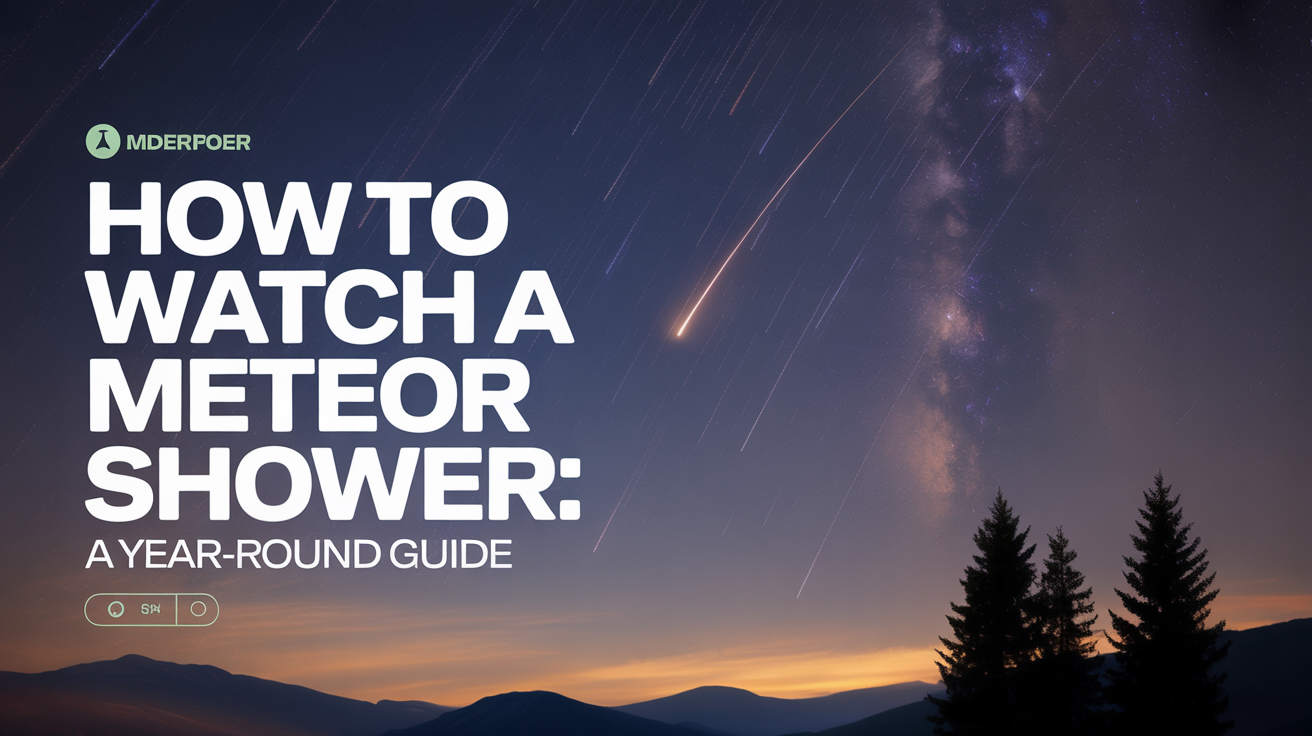
Pick a clear night when a major shower peaks, drive away from city lights, lie back on a blanket, and look up. That is the core of it. No telescope, no binoculars, no star charts required. What you do need is a bit of patience, some preparation, and an understanding of why certain nights produce far more meteors than others.
What Causes a Meteor Shower
A meteor shower happens when Earth's orbit carries it through a stream of debris left behind by a comet (or, in a few cases, an asteroid). The debris is mostly sand-grain-sized particles. When those particles hit our atmosphere at tens of kilometers per second, they burn up in a flash of light. Because Earth is moving in a fixed direction through the stream, the meteors appear to radiate outward from a single point in the sky called the radiant. Showers are named after the constellation that contains their radiant: the Perseids' radiant lies in Perseus, the Leonids' in Leo, and so on.
Knowing where the radiant sits matters for one reason: you don't want to stare directly at it. Meteors near the radiant look short and stubby. The longer, more dramatic streaks appear 45 to 60 degrees away. So find the radiant, then let your eyes wander to the surrounding sky.
Why After Midnight Is Almost Always Better
This is one of the most counterintuitive parts of meteor watching, but the geometry is simple. In the hours before midnight, you're on the side of Earth that is "trailing" through space, so meteors have to catch up to you. After midnight, you're on the leading side, plowing headfirst into the debris stream. Rates roughly double or triple between midnight and dawn. For the best showers, setting an alarm for 2 or 3 a.m. pays off noticeably.
The one exception is the radiant's altitude. If a shower's radiant doesn't clear the horizon until well after midnight in your latitude, early evening watching is mostly wasted anyway. Check the radiant's rise time for your location before you plan the outing.
The Major Annual Showers
The calendar below covers the showers most worth planning around. ZHR (Zenithal Hourly Rate) is a theoretical maximum, calculated assuming the radiant is directly overhead and the sky is perfectly dark. Real-world counts are usually 30 to 50 percent of ZHR, sometimes less, depending on moonlight, horizon obstructions, and how long you can keep your eyes adapted to the dark.
| Shower | Approximate Peak | Approx. Peak ZHR | Parent Body |
|---|---|---|---|
| Quadrantids | Early January | ~120 | Asteroid 2003 EH1 |
| Lyrids | Late April | ~18 | Comet Thatcher |
| Eta Aquariids | Early May | ~50–70 | Comet Halley |
| Perseids | Mid-August | ~100 | Comet Swift-Tuttle |
| Orionids | Late October | ~20–25 | Comet Halley |
| Leonids | Mid-November | ~15 (storm years rare) | Comet Tempel-Tuttle |
| Geminids | Mid-December | ~120–150 | Asteroid 3200 Phaethon |
| Ursids | Late December | ~10 | Comet Tuttle |
A few notes worth keeping in mind:
Quadrantids have an unusually narrow peak (sometimes just a few hours), which makes them easy to miss. They also peak in early January when temperatures are brutal in the northern hemisphere.
Eta Aquariids favor southern hemisphere observers because the radiant climbs higher for them. Northern observers still see decent rates but the radiant stays low.
Perseids are the go-to shower for most people: they peak in mid-August when nights are warm and the shower is reliably active for several nights around the peak. A solid Perseids viewing guide really comes down to finding dark skies and checking the Moon phase. For more on planning around moonlight, see how the Moon's phases affect stargazing.
Geminids are arguably the best shower of the year on raw numbers, but December cold keeps many observers indoors. The Geminids are also unusual because their parent body is an asteroid rather than a comet. They're worth bundling up for.
Leonids occasionally produce intense storms (thousands per hour) when Earth passes through a dense filament of debris, but those are rare and unpredictable. In ordinary years, expect modest rates.
Practical Meteor Shower Tips
Choose a Dark Location
Light pollution is the single biggest obstacle. Even a modest amount of sky glow washes out fainter meteors, which make up the majority of any shower. A limiting magnitude of 6.5 or better (the faintest star you can see with the naked eye) is ideal. Driving 30 to 45 minutes from a city center often improves conditions substantially.
Online dark-sky maps can help you find a suitable spot. State parks, rural farmland, and high-altitude sites away from highway corridors all work well.
Let Your Eyes Adapt
Dark adaptation takes about 20 to 30 minutes. Your eyes are producing rhodopsin (a light-sensitive pigment) the whole time, and the process is fragile: one glance at a bright phone screen sets you back to square one. Use a red flashlight for any tasks that require light. Red wavelengths minimally disrupt night vision.
Get Comfortable for the Long Haul
Lying flat on a reclining camp chair or a sleeping pad lets you cover a wide swath of sky without straining your neck. Dress warmer than you think you need to. Even in summer, temperatures drop significantly between midnight and dawn, and being cold makes you want to leave early.
Bring snacks and something hot to drink. Meteor watching is leisurely by nature; you'll be staring at the sky for an extended stretch with nothing to do but wait.
Dealing with the Moon
A bright Moon can halve or worse your observed count by illuminating the sky background. A full Moon near the peak of a shower is the main reason some showers are worth skipping in a given year. A waxing or waning crescent, or a Moon that sets before midnight, barely affects the experience.
Check the Moon's phase and its rise/set times alongside the shower's peak date. If the Moon is full within a few days of the peak, either lower your expectations or target the hours after moonset.
No Telescope, No Binoculars
Telescopes and binoculars magnify small patches of sky, which is exactly the wrong approach for meteors that streak unpredictably across wide areas. Your widest field of view (unaided eyes) is always the right tool. Some observers like to split a group: one person sweeps a darker patch away from the radiant while another watches a different region, then they compare notes.
Connecting Showers to the Broader Night Sky
The radiant's position is easier to find if you already know the major constellations. Perseus is prominent in the autumn and winter sky; Gemini anchors the winter hexagon; Leo rises in the east through late winter and spring. Brushing up on seasonal constellations before a shower makes it easier to orient yourself quickly once you're in the field.
While you're waiting for meteors, the rest of the sky deserves attention. Any bright "stars" that don't twinkle are likely planets. Knowing what's up on a given night sharpens the overall experience. Our guide to finding the visible planets in the night sky walks through the quick ways to identify them.
Frequently Asked Questions
How many meteors will I actually see?
Expect 10 to 30 per hour on a good night for a solid shower like the Perseids, assuming dark skies and no Moon interference. Rates climb closer to dawn and fall short of the theoretical ZHR for most observers. Some nights deliver surprises in either direction.
Do I need to know where the radiant is?
You don't need to find it precisely, but knowing the general direction helps. Aim your gaze 45 to 60 degrees away from the radiant to catch the longest meteor trails. If you're watching Geminids, that means facing generally away from Gemini rather than directly at it.
Is a moonlit night worth bothering with?
A thin crescent or quarter Moon won't ruin a shower; you'll lose the faintest meteors but still see the bright ones. A gibbous or full Moon is a significant problem. If the Moon is bright and doesn't set until well after midnight, it's usually worth waiting for a night when conditions are better, or watching during the short window after the Moon sets and before dawn.
What's the best shower for beginners?
The Perseids in August are the easiest entry point: warm nights, consistent activity for several nights around the peak, a radiant high in the northern sky, and rates reliable enough that most observers see something within 15 minutes of watching. Start there before chasing the Geminids in December cold.
Can I photograph meteor showers?
Yes, with a DSLR or mirrorless camera and a wide-angle lens. Set your aperture as wide as it goes (f/1.8 to f/2.8), ISO between 1600 and 6400, and expose for 20 to 30 seconds. Point the camera away from the radiant and away from the Moon. You'll capture meteors alongside the star field, and stacking multiple frames later reveals the radiant pattern. A remote shutter release and a sturdy tripod are nearly essential.