Sky This Month
The Moon's Phases Explained and How They Affect Stargazing
Learn why the moon has phases, what each of the 8 lunar phases looks like, and how to plan better stargazing sessions around the lunar cycle.
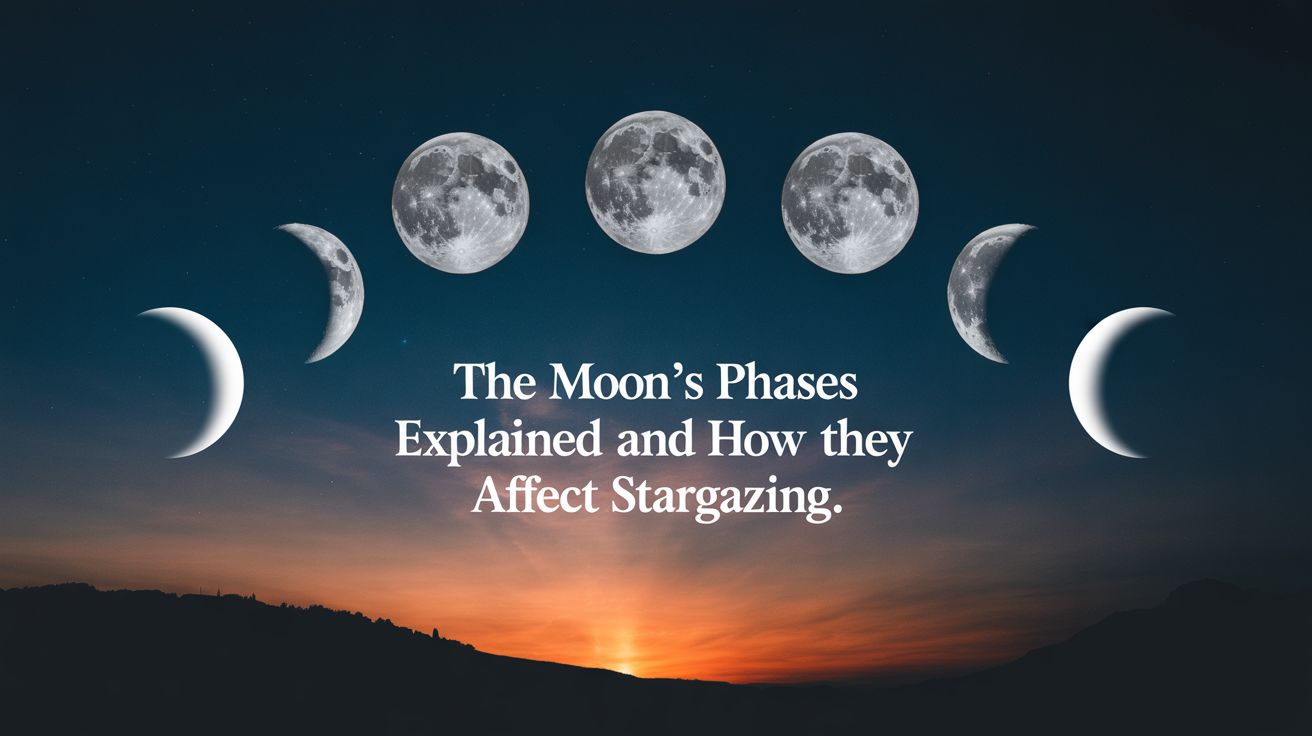
Every 29.5 days, the Moon completes a full cycle from new to full and back again. If you've ever stepped outside to observe a faint galaxy cluster and been blinded by a bright Moon hanging overhead, you already understand the practical side of this. Knowing where the Moon is in its cycle is one of the most basic (and most useful) planning skills a visual observer can develop.
At a Glance
- The Moon takes 29.53 days to cycle from new to new (the synodic period); this is longer than its 27.3-day orbit around Earth because Earth itself is also moving around the Sun.
- New moon (roughly 5-6 nights centered on it) is prime time for deep-sky targets, the Milky Way, and meteor showers; full moon is the worst time for anything faint.
- First quarter and last quarter, not full moon, give the sharpest lunar surface views because shadows along the terminator reveal crater relief.
- Moonrise shifts about 50 minutes later each day, so a Moon that rises at 9 p.m. tonight rises near 11 p.m. a week from now, opening up more dark-sky hours before it appears.
- The USNO's phase calculations define the four primary phases by the Moon-Sun angle: 0°, 90°, 180°, and 270°, which is why phase timing is precise down to the minute, not a rough guess.
- Planets barely care about moon phase; constellation learning and casual stargazing actually benefit from a little moonlight to see by.
Why the Moon Has Phases
The phases aren't caused by Earth's shadow falling on the Moon. That's a lunar eclipse, which is a separate event. Phases happen because the Moon orbits Earth, and as it moves, we see different fractions of its sunlit half from our vantage point on the ground.
Think of it this way: the Sun always lights one hemisphere of the Moon. As the Moon travels around Earth over roughly 29.5 days (called the synodic period, measured from one new moon to the next), our viewing angle on that lit hemisphere shifts continuously. When the Moon sits between Earth and the Sun, the lit side faces away from us entirely: new moon. When Earth is between the Moon and Sun, we see the lit side fully: full moon.
The geometry is simple, but its consequences for night-sky observing are enormous. The U.S. Naval Observatory, which maintains the official reference calculations for phase timing, defines the four primary phases by the angular separation between the Moon and Sun as seen from Earth: new moon at 0 degrees, first quarter at 90, full moon at 180, and last quarter at 270. That precision is why phase-change times are published down to the minute rather than "sometime this week."
The 8 Phases and What You Can Observe at Each
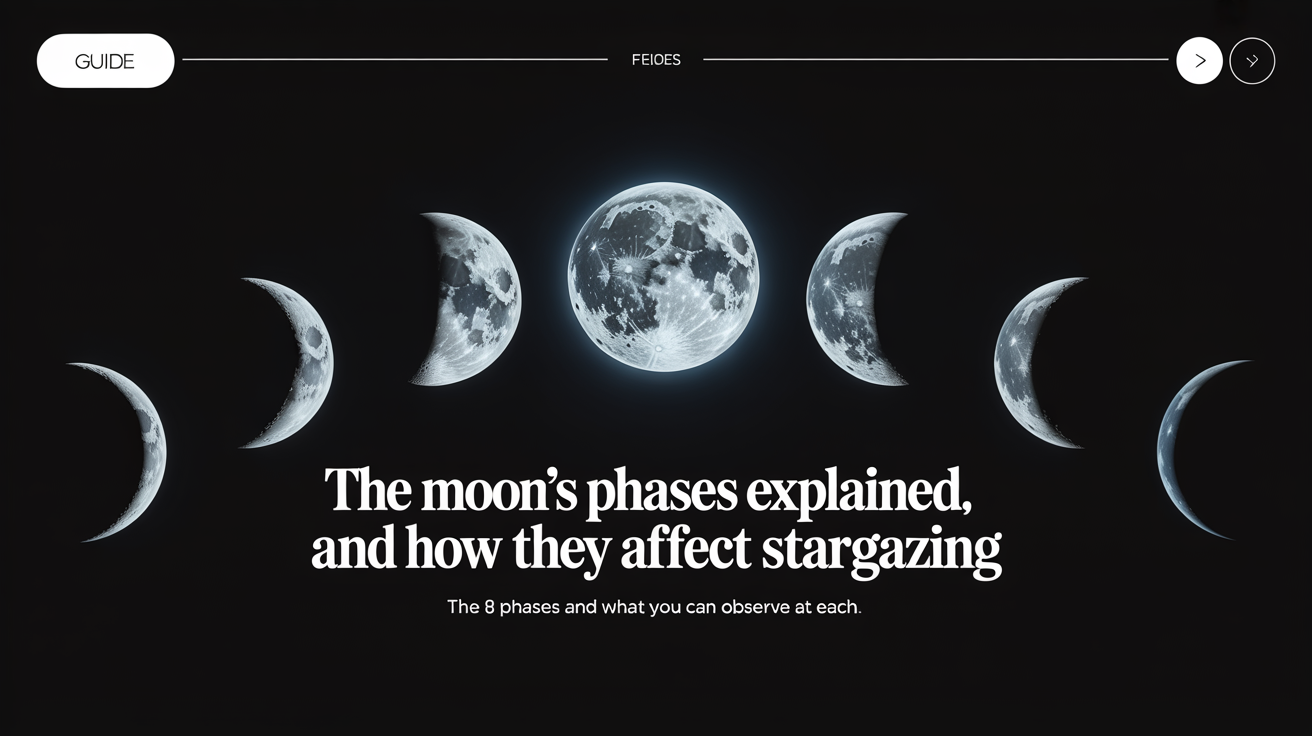
The Moon passes through eight distinct phases, each offering something different to the observer.
| Phase | Illumination | Best Viewing Time | What to Look For |
|---|---|---|---|
| New Moon | ~0% | Not visible | Deep-sky objects, faint nebulae, Milky Way core |
| Waxing Crescent | 1–49% | Evening, sets early | Earthshine on the dark limb; thin crescent near sunset |
| First Quarter | ~50% | Evening to midnight | Terminator line; dramatic crater shadows |
| Waxing Gibbous | 51–99% | Evening through late night | Expanding crater detail; increasingly bright |
| Full Moon | ~100% | All night | Bright ray systems (Tycho, Copernicus); poor for deep-sky |
| Waning Gibbous | 99–51% | Late night through dawn | Craters and mare detail in early morning |
| Last Quarter | ~50% | Midnight to morning | Second terminator pass; excellent crater depth |
| Waning Crescent | 49–1% | Pre-dawn | Thin crescent before sunrise; earthshine again |
A quick mnemonic that actually works: waxing means the lit portion is growing (toward full), and waning means it's shrinking (away from full). Waxing phases dominate the evening sky; waning phases belong to the morning. If you only remember one rule, remember this: any phase name starting with "waxing" is visible right after sunset, and any phase starting with "waning" is visible before sunrise.
Lunar Cycle Quick-Reference Table
Here's roughly where the Moon sits, and how much dark sky you get, at each stage of a typical 29.5-day cycle. Times are approximate and will shift with your latitude and the season.
| Days from new moon | Phase | Rises around | Sets around | Dark-sky window that night |
|---|---|---|---|---|
| 0 | New | With the Sun | With the Sun | All night |
| 4 | Waxing crescent | Late morning | ~9 p.m. | ~9 p.m. to dawn |
| 7 | First quarter | Noon | ~midnight | Midnight to dawn |
| 11 | Waxing gibbous | Late afternoon | ~3 a.m. | Only a few pre-dawn hours |
| 14–15 | Full | Sunset | Sunrise | None |
| 18 | Waning gibbous | ~9 p.m. | Mid-morning | Dusk until moonrise |
| 22 | Last quarter | Midnight | Noon | Dusk to midnight |
| 26 | Waning crescent | Early morning | Afternoon | Almost all night |
The pattern that matters most for planning: the five or six nights bracketing day 0 (new moon) and, to a lesser extent, the nights right around day 22 to 26, give you the longest true-dark windows without waiting up past midnight.
The Terminator: The Moon's Most Rewarding Feature
Lunar observers learn early that the full moon is paradoxically one of the worst times to study the Moon's surface in detail. When the Sun hits the lunar surface head-on, craters look flat and washed out. The most dramatic views come along the terminator, the line separating lunar day from night.
At first quarter and last quarter, shadows stretch long across crater floors, ridge lines cast dark relief, and the mountains around Mare Imbrium throw shadows dozens of kilometers across the basalt plain. This is when features like Clavius, Plato, and the Apennine range reveal their full three-dimensional character. Clavius alone is roughly 225 kilometers across, one of the largest craters visible from Earth, and along the terminator its floor fills with a chain of progressively smaller craters that stand out in sharp relief for only a night or two each cycle before the changing sun angle flattens them again.
First quarter puts the terminator on the eastern half of the near side, revealing much of the rugged southern highlands. Last quarter shifts it to the west, illuminating Oceanus Procellarum and the volcanic plains more dramatically. Both phases are worth a dedicated session with even a modest telescope. Because the Moon moves roughly 12 degrees eastward against the stars each day, the terminator itself creeps across the disk at about the same rate, so a crater that looked flat and unremarkable last night can look completely different tonight.
New Moon vs Full Moon for Deep-Sky Stargazing
For anything beyond the Moon itself, the new moon period is when serious observing happens.
A full moon raises the sky background brightness enough to wipe out faint targets entirely. Globular clusters lose their outer halos. Emission nebulae like the Veil or the California Nebula become difficult or impossible without a narrowband filter. The Milky Way's dust lanes fade into a gray smear. The difference between observing the Virgo Cluster at new moon versus full moon isn't subtle; it can be the difference between counting a dozen galaxies and seeing almost none.
The sweet spot for deep-sky work is the five to six nights centered on new moon, when the Moon either doesn't rise or sets well before astronomical twilight ends. During this window, conditions that would otherwise require a dark-sky site become achievable from suburban locations. If you're trying to catch a meteor shower, that same dark window applies. The annual meteor shower guide covers how lunar phase affects peak viewing night by night.
Waning and waxing crescent phases offer workable windows too. A thin crescent sets in early evening or rises in early morning, leaving the prime hours of darkness largely uncontaminated. As a rough rule of thumb, any night where the Moon is below about 25 percent illuminated and not in the sky during your observing window will perform close to a true moonless night for anything but the very faintest targets.
Planning Observations Around the Lunar Cycle
Practical scheduling takes about two minutes once you know the pattern.
For planets, the Moon's phase matters less. Jupiter, Saturn, and Mars are bright enough that the full moon doesn't obscure them, though a nearby full moon can reduce contrast on planetary detail slightly. Our guide to finding the visible planets covers how to track them regardless of lunar conditions.
For constellation tours and learning the night sky, the Moon is actually a helpful companion. First-quarter Moon in the evening sky gives you a useful reference point without destroying your dark adaptation entirely. If you're just starting out and trying to identify Orion, Scorpius, or the Summer Triangle, some ambient moonlight makes the experience more comfortable. The seasonal constellation guide pairs well with a first-quarter night.
A simple monthly plan that works:
- New moon week: Deep-sky targets, Milky Way photography, meteor showers
- First quarter: Lunar surface observing, planet hunting, learning constellations
- Full moon: Wide-field photography, astrophotography of moonlit landscapes, bright clusters
- Last quarter: Morning lunar sessions, pre-dawn planet observation
Earthshine and Other Visual Details
During the crescent phases, you'll sometimes see the entire disk of the Moon faintly glowing even on the unlit portion. This is earthshine, sunlight that has bounced off Earth's surface and oceans and then reflected off the Moon back to your eyes. It was described famously by Leonardo da Vinci in the early 1500s.
Earthshine is most visible within a few days of new moon when the crescent is thin, and it offers a rare chance to see surface features on the dark limb with binoculars. The brightness of earthshine also varies with cloud cover on Earth; a heavily clouded Earth reflects more sunlight, making earthshine brighter.
At full moon, look for the ray systems radiating from relatively young impact craters. Tycho, in the southern highlands, has rays that extend across a quarter of the lunar disk. Copernicus, in the Oceanus Procellarum region, has its own distinctive ray pattern. These bright streaks are pulverized regolith thrown outward by the impacts and are most visible under high illumination when the terminator isn't producing the shadows that make other features pop. Tycho is a comparatively young crater at around 108 million years old, which is part of why its ray system is still so bright; older ray systems fade as micrometeorite impacts slowly darken the exposed material over geologic time.
Frequently Asked Questions
How long is the lunar cycle exactly?
The synodic period (new moon to new moon) averages 29.53 days. It varies slightly because the Moon's orbit is elliptical; when the Moon is closer to Earth (near perigee), it moves faster, slightly compressing the cycle. This variation is also why "supermoons" occur: a full moon near perigee can appear up to 14 percent bigger and 30 percent brighter than the faintest, most distant full moon of the year, though the difference is subtle to the naked eye and easy to miss without a side-by-side comparison photo.
Does the Moon rise and set at the same time every night?
No. The Moon rises roughly 50 minutes later each day on average (with considerable variation), which is why the window of dark sky before moonrise shifts steadily through the month. A Moon that rises at 9 p.m. this week will rise around 11 p.m. next week, giving you two more hours of dark sky before it appears.
Why does the full moon look orange when it rises?
Low altitude, not phase. When the Moon is near the horizon, its light travels through a much thicker slice of atmosphere than when it's overhead. The atmosphere scatters shorter blue wavelengths and lets longer red and orange wavelengths through. The same effect turns sunsets orange. A rising full moon is no different in color from a rising crescent; it just has enough light to make the orange tint vivid.
Can I observe the Moon through a telescope during the day?
Yes, and daytime lunar observing is underrated. The Moon is frequently visible in the daytime sky during its waxing and waning phases, and the view through a telescope is safe as long as you're not near the Sun (never sweep toward the Sun with any optic). Daytime lunar sessions during first quarter are particularly good because the terminator is well-placed and the Moon is high enough for steady seeing.
How do I find out the current moon phase?
Any basic astronomy app (Stellarium, SkySafari, Heavens-Above) shows the current phase and rise and set times, and the U.S. Naval Observatory's data services publish the official phase and illumination figures those apps are built on. Most apps also let you step forward or backward in time, which makes it easy to plan an observing session weeks in advance around a new moon window or a favorable meteor shower date.
Is the exact same face of the Moon always lit the same way at a given phase?
Not quite. Because of libration, a slow wobble in the Moon's orientation as seen from Earth, the visible disk tips slightly north-south and east-west over the month, exposing thin slivers along the limb that aren't visible at other times. It's a small effect, a few degrees at most, but it means a first quarter Moon in January and a first quarter Moon in June won't look pixel-for-pixel identical near the edges.