Planets & Deep Sky
Observing Venus and Mars: What Beginners Can Realistically See
Honest guide to observing Venus and Mars through a telescope. Learn what phases, colors, and surface details beginners can actually spot.
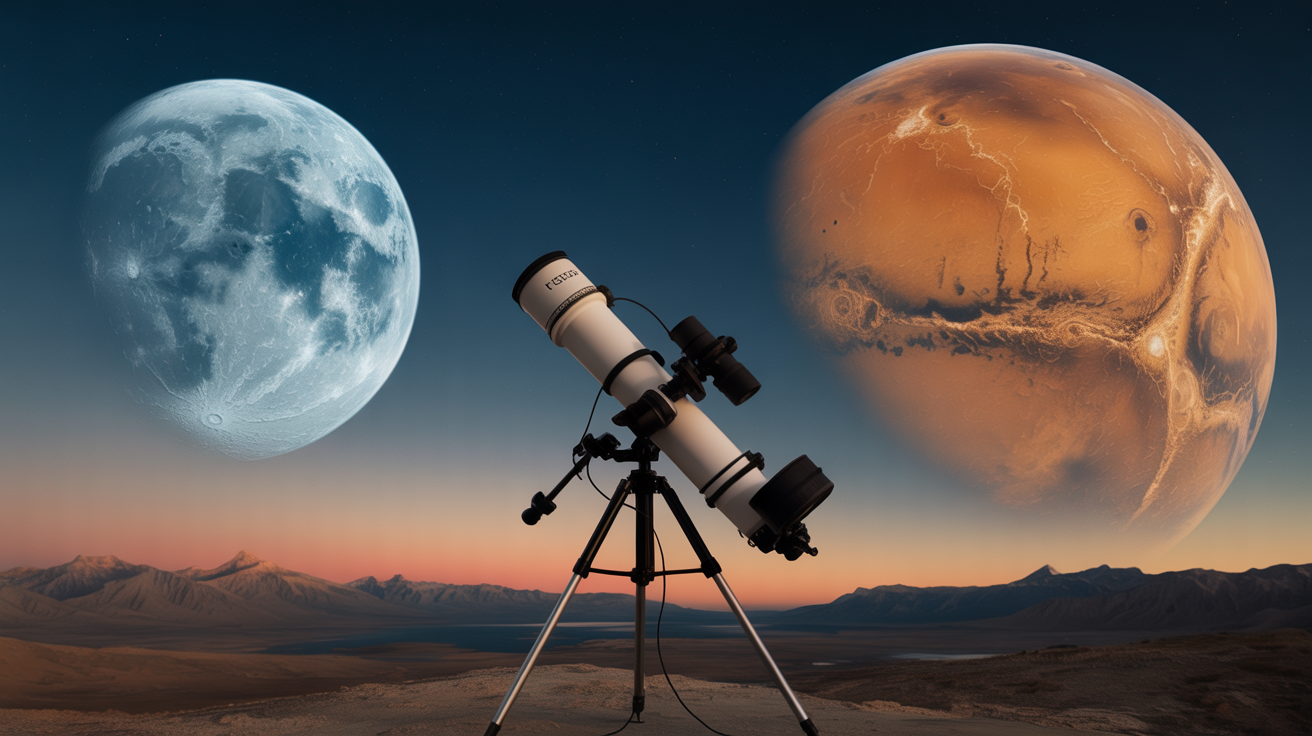
Venus and Mars are two of the brightest objects in the night sky, and both are genuinely rewarding to watch through a telescope once you know what to look for and what not to expect.
Venus: Brilliant but Featureless
Venus is almost always the brightest planet visible from Earth. On a clear evening or morning it can cast a faint shadow. This brightness leads many beginners to expect spectacular views through the eyepiece. The honest answer is that Venus shows one impressive feature and nothing else.
What you will see: Phases. Venus orbits closer to the Sun than Earth does, so it goes through a full cycle of phases just like the Moon. Through even a 60mm refractor at 50x magnification, Venus shows a clearly crescent-shaped disk when it is near inferior conjunction (between Earth and the Sun) and a smaller, fuller disk when it is on the far side of the Sun. The phase change is genuinely striking. A crescent Venus near maximum elongation spans roughly 40 arcseconds across, which makes it one of the largest planetary disks in the sky at that time.
What you will not see: Surface features. Venus is wrapped in a thick, unbroken layer of sulfuric acid clouds that block all visible light from the ground below. No amount of aperture, no color filter, no planetary camera will show you volcanoes or mountains. The disk is uniform white or cream. Some experienced observers claim to see subtle cloud banding under very steady seeing, but beginners should not expect this.
When to Observe Venus
Venus stays within about 47 degrees of the Sun at all times, so it is always an evening or morning object. It never rises near midnight. Look west after sunset when it appears as an "evening star," or east before sunrise when it appears as a "morning star." It swings from one side to the other over a roughly 19-month synodic cycle.
The best time to watch the phase change is over several weeks when Venus is between greatest elongation (its widest angular separation from the Sun, around 45 degrees) and inferior conjunction. During this stretch the crescent gets thinner and larger at the same time. Many beginners are surprised that Venus looks biggest when it is a thin crescent because the planet is physically closest to Earth at that point.
Magnification for Venus
Start at 50x to 80x to identify the phase and get a feel for the disk. You can push to 100x to 150x on a stable night, but higher power rarely reveals additional detail on Venus. A UV or blue filter (Wratten 47 or 80A) is sometimes used by advanced observers to coax out faint cloud structure, but results vary and are not guaranteed for beginners.
Venus can be bright enough to cause glare. Observing it during twilight rather than against a fully dark sky makes the view more comfortable and often sharper.
Mars: The Red Planet Requires Patience
Mars is the planet that disappoints beginners more than any other. Photographs from space probes show a world of canyons, volcanoes, and polar ice caps. Through a small backyard telescope on a random night, Mars often looks like a tiny orange dot with no detail at all. Understanding why helps you choose the right moment to look.
Angular size is the core problem. Mars ranges from about 3.5 arcseconds across at its farthest from Earth to around 25 arcseconds at a favorable opposition. For comparison, Jupiter near opposition spans roughly 45 arcseconds and shows obvious cloud bands at very low power. At 3.5 arcseconds, Mars is smaller than the disk of Uranus, and no telescope will show surface features at that size through Earth's turbulent atmosphere.
What you can see near opposition: When Mars is within a few weeks of opposition (when Earth passes between Mars and the Sun, roughly every 26 months), surface features become visible to patient observers under good seeing. A 6-inch or larger telescope at 150x to 200x can show:
- The bright polar cap (usually the north or south cap depending on the Martian season)
- Syrtis Major, a dark triangular region that is one of the most prominent features on the planet
- Other large dark maria that contrast against the ochre-colored terrain
- Occasional bright orographic clouds over volcanic highlands
These are real, repeatable features. They are also subtle. You need steady atmospheric seeing and a dark-adapted eye to see them clearly.
Mars Opposition: Timing Your Best Views
Mars oppositions are not all equal. Because Mars has an elliptical orbit, oppositions that happen when Mars is near perihelion (closest point to the Sun) bring it significantly closer to Earth. The 2003 opposition put Mars just under 56 million kilometers away and produced a disk over 25 arcseconds across. An opposition near aphelion might yield only 14 arcseconds.
The months leading up to and just after opposition are your window. Mars rises earlier each night as opposition approaches, eventually rising at sunset and staying up all night near the event. Plan to observe when Mars is highest in the sky, above the thickest part of Earth's atmosphere, which is typically around local midnight or a bit after when the planet transits your meridian.
Mars rotates in about 24 hours and 37 minutes, so observing at the same hour on consecutive nights gives you a slowly rotating tour of the surface.
Magnification for Mars
At opposition, try 100x to start and work up to 150x or 200x if the seeing allows. Seeing is the biggest limiting factor with Mars. A night that looks clear to the naked eye can have terrible high-altitude turbulence that turns the Mars disk into a shimmering smear. A night of excellent seeing with some thin haze can give a rock-steady, detailed view.
A light red or orange filter (Wratten 21 or 25) increases contrast between dark and light regions on Mars by blocking blue light. This can make albedo features more obvious. A blue filter helps with seeing the polar cap and any cloud activity.
Comparing Venus and Mars Side by Side
| Feature | Venus | Mars |
|---|---|---|
| Best time to observe | Near greatest elongation (evening or morning twilight) | Within 1 month of opposition |
| Disk size range | 10 to 64 arcseconds | 3.5 to 25 arcseconds |
| What beginners see | Distinct crescent to gibbous phases | Orange disk; detail only near opposition |
| Surface features visible | None (cloud cover) | Polar cap, dark maria near opposition |
| Useful magnification | 50x to 150x | 100x to 200x |
| Limiting factor | Featureless cloud deck | Seeing and distance from Earth |
Getting the Most from Both Planets
A few habits make a real difference when observing planets through a telescope.
Let your eye adapt and let the telescope cool. Your eyes need 20 minutes in the dark to reach full sensitivity. Your telescope mirror or lens also needs time to reach thermal equilibrium with the outside air, otherwise tube currents will blur the image. Give it at least 30 minutes outside before critical observing.
Watch the seeing, not just the sky. When a star near the horizon shimmers and twinkles, the seeing is poor. A star overhead that appears as a steady point means the atmosphere is calm. On poor-seeing nights, planetary detail washes out regardless of aperture. When the seeing is exceptional, even a modest 4-inch telescope can deliver memorable views of Mars near opposition.
Start with planets you can learn the most from. Observing Jupiter and its four Galilean moons gives beginners a faster return for their time because Jupiter's disk is large and changes are visible from night to night. Saturn's rings are another early win because they are unmistakable even at 50x. Mars and Venus fit into a broader solar system tour once you have a feel for how planets behave through an eyepiece. The Moon is always a good practice target for learning to read atmospheric seeing before a planetary session.
Frequently Asked Questions
Can I see the phases of Venus without a telescope?
No. The human eye cannot resolve Venus into a disk shape unaided. Its phase is visible only through binoculars or a telescope. Even at 7x binoculars, the crescent shape is detectable near inferior conjunction when the disk is large.
Why does Mars look orange?
Mars's soil is rich in iron oxide, which gives the surface its reddish-orange color. This tint comes through even in a small telescope when the planet is near opposition and the disk is large enough to show color clearly.
How often does Mars come to opposition?
Roughly every 26 months, because Earth gains one full lap on Mars in that time. Favorable perihelic oppositions (when Mars is also close to perihelion) happen about every 15 to 17 years. The next few oppositions are worth checking an astronomy almanac for exact dates and angular sizes.
Why can't I see surface features on Mars right now?
If Mars is far from opposition, its disk may be too small for surface features to resolve through typical amateur equipment, even with good seeing. A 4-inch telescope needs Mars to be at least 8 to 10 arcseconds in diameter to show any albedo features. Check the current angular size before planning a session.
Does a bigger telescope help with Venus?
For seeing phases, any telescope works fine. A larger aperture shows a sharper edge on the crescent and may let you push slightly higher magnification, but it will not reveal surface features because there are none to see in visible light. Extra aperture makes more difference on Mars, where it helps resolve smaller and fainter albedo features near opposition.