Observing Skills
Right Ascension and Declination: Sky Coordinates Made Simple
Right ascension and declination explained for beginners. Learn how celestial coordinates work, why RA uses hours, and how to use them with star charts.

Right ascension and declination are the celestial equivalents of longitude and latitude, giving every star and deep-sky object a fixed address in the sky. Once you understand how they work, star charts and telescope setting circles start making a lot more sense.
At a Glance
- Declination is celestial latitude, measured in degrees from -90 at the south celestial pole to +90 at the north.
- Right ascension is celestial longitude, but measured in hours (0h to nearly 24h) instead of degrees, because the sky turns 15 degrees per hour.
- Coordinates come from the equatorial coordinate system, and they stay essentially fixed for a human lifetime, so a catalog value from decades ago still points to the right spot.
- Your latitude on Earth sets which declinations are circumpolar (never set) and which never rise above your horizon at all.
- Setting circles on manual mounts and the internal logic of GoTo mounts both work by matching RA and Dec, so understanding the system helps you troubleshoot a bad slew.
- You do not need RA and Dec to enjoy casual star-hopping, but the system becomes essential the moment you start working from a catalog instead of memory.
The Celestial Sphere: A Grid Projected onto the Sky
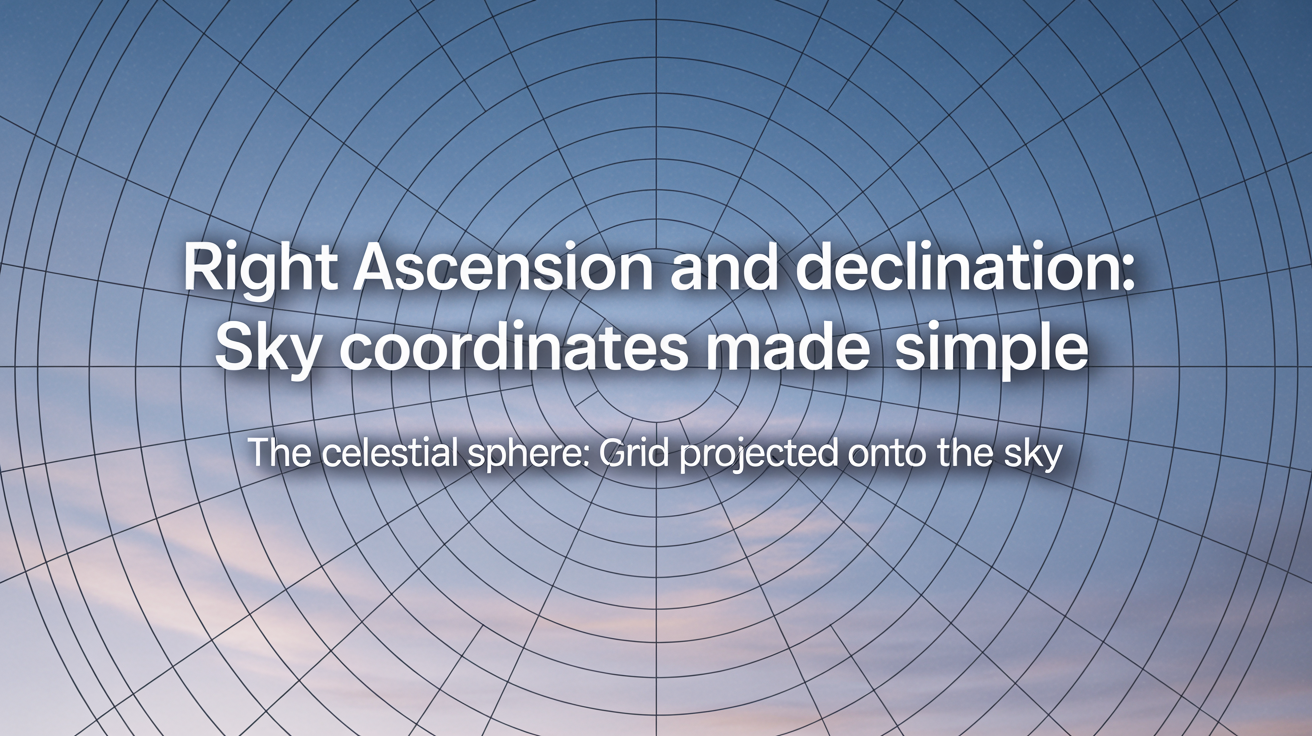
Astronomers treat the sky as if it were a giant hollow sphere surrounding Earth, with our planet at the center. This is the celestial sphere. The stars are pinned to its inner surface, and a coordinate grid is drawn on it much the same way a coordinate grid is drawn on a globe.
Because the stars are so far away, their positions within this grid barely change over a human lifetime. A star's coordinates remain essentially the same from year to year, which means you can look up an object's location in a catalog, then find it at the eyepiece using those numbers.
The grid has two reference lines that anchor everything else. The celestial equator is a projection of Earth's equator out onto the celestial sphere. The celestial poles are projections of Earth's north and south poles. Polaris, the North Star, sits very close to the north celestial pole, which is why it barely moves while the rest of the sky wheels around it each night.
Declination: The Latitude of the Sky
Declination (abbreviated Dec or the Greek letter delta) measures how far north or south an object sits from the celestial equator, the angular distance from the celestial equator on the celestial sphere. It works exactly like terrestrial latitude.
- The celestial equator is 0 degrees declination.
- The north celestial pole is +90 degrees.
- The south celestial pole is -90 degrees.
- Objects north of the celestial equator have positive declination.
- Objects south of it have negative declination.
Polaris has a declination of about +89.3 degrees, meaning it sits just 0.7 degrees from the north celestial pole. The Orion Nebula sits at roughly -5 degrees, placing it just south of the celestial equator. The Southern Cross (Crux) has a declination around -60 degrees, which puts it permanently below the horizon for most observers in the northern United States and Europe.
Your latitude on Earth determines which declinations you can observe. From a latitude of 40 degrees north, objects with declinations above +50 degrees never set (they are circumpolar), and objects below about -50 degrees declination never rise above your horizon. The rule is simple arithmetic: subtract your latitude from 90 to get the declination cutoff in both directions.
How Much Sky You Can See, by Latitude
| Your latitude | Example city | Circumpolar above Dec | Never rises below Dec |
|---|---|---|---|
| 25°N | Miami, Houston | +65° | -65° |
| 30°N | New Orleans, Cairo | +60° | -60° |
| 35°N | Memphis, Tokyo | +55° | -55° |
| 40°N | New York, Denver, Madrid | +50° | -50° |
| 45°N | Minneapolis, Milan, Portland | +45° | -45° |
| 50°N | London, Prague, Winnipeg | +40° | -40° |
Everything between the two cutoffs at your latitude rises and sets each night, just at different times of year depending on right ascension. This is why observers at high northern latitudes never see the Southern Cross (Dec around -60 degrees) or the core of the Milky Way's brightest star fields, while observers near the equator eventually see almost everything over the course of a year.
Right Ascension: Longitude Measured in Hours
Right ascension (abbreviated RA or the Greek letter alpha) is the sky equivalent of longitude, but with one important difference: it is measured in hours, minutes, and seconds rather than degrees.
The reason is practical. Earth rotates 360 degrees in roughly 24 hours, so the sky appears to turn at a rate of 15 degrees per hour. Astronomers found it convenient to mark off the sky in the same units as a clock, because it makes it easy to figure out when an object will be overhead. One hour of right ascension equals 15 degrees of arc.
The full scale runs from 0 hours to 23 hours 59 minutes 59 seconds, and it increases from west to east along the celestial equator. The zero point is called the vernal equinox, the location where the Sun crosses the celestial equator heading northward each spring. That point is fixed on the celestial sphere, even though the Sun only passes through it once a year.
A few familiar objects and their coordinates:
| Object | Right Ascension | Declination |
|---|---|---|
| Orion Nebula (M42) | 5h 35m | -5 deg 23' |
| Andromeda Galaxy (M31) | 0h 42m | +41 deg 16' |
| Beehive Cluster (M44) | 8h 40m | +19 deg 59' |
| Ring Nebula (M57) | 18h 53m | +33 deg 02' |
| Omega Centauri (NGC 5139) | 13h 26m | -47 deg 29' |
These numbers come from standard catalogs and stay accurate for years. When you look up a Messier or NGC object, the coordinates listed are right ascension and declination.
How to Use RA and Dec in Practice
On Paper Star Charts and Atlases
Printed star atlases like the Cambridge Double Star Atlas or Uranometria include a coordinate grid. The declination lines run parallel to the celestial equator, labeled in degrees. The right ascension lines run perpendicular, labeled in hours. To find an object, you read its RA and Dec from a catalog, then trace the corresponding grid lines until they cross.
Apps like SkySafari and Stellarium display the same grid and let you search by coordinates directly. Typing in the RA and Dec of a faint galaxy will center the chart on its location.
With Setting Circles on a Manual Mount
Equatorial mounts have two graduated circles, one for each axis. The declination circle reads in degrees. The right ascension circle reads in hours. To use them:
- Polar-align your mount so the right ascension axis points at the celestial pole.
- Point at a known bright star and dial in its RA and Dec on the setting circles.
- To find your next target, turn the mount in right ascension and declination until both circles show the target's coordinates.
Setting circles on budget equatorial mounts are often imprecise, easily off by a degree or two once backlash and a slightly imperfect polar alignment are factored in. That is close enough to land a target in a low-power, wide-field eyepiece but not close enough to center it at high magnification, so plan on a final visual nudge once the field comes into view. Star-hopping from a nearby bright star is often faster for objects within a few degrees of a known landmark, and it does not require a polar alignment.
With a GoTo Telescope
GoTo computerized mounts use the same coordinate system internally. When you complete a two or three-star alignment and tell the hand controller to slew to M57, it calculates the current RA and Dec of the Ring Nebula and drives both motors to point there. Understanding RA and Dec helps you make sense of what the controller is doing and troubleshoot when a slew lands in the wrong part of the sky. A slew that consistently misses by the same rough distance and direction usually means the alignment stars were chosen too close together, or one of them was mis-identified during setup; redoing the alignment with stars spread widely across the sky, ideally on opposite sides of the meridian, tends to fix it.
A Worked Example: Estimating Transit Altitude
Once you are in the right area of sky, a finderscope or red-dot finder helps you star-hop to the target. For faint nebulae or galaxies once you are on the right field, try averted vision to pull out detail that direct gaze misses.
The formula for how high an object climbs at transit (its highest point, when it crosses the meridian) is: altitude = 90 minus your latitude, plus the object's declination. Take the Hercules globular cluster M13, at declination +36 degrees 33 minutes, from a latitude of 40 degrees north: 90 minus 40 plus 36.55 works out to about 86.5 degrees, nearly straight overhead. Compare that to M42, the Orion Nebula, at declination -5 degrees 23 minutes, from the same latitude: 90 minus 40 minus 5.4 comes to about 44.6 degrees, a moderate altitude well clear of horizon murk. Running this arithmetic before a session tells you which targets will sit in a clean, high patch of sky and which will stay low and hazy all night.
Why RA Changes with the Seasons (and Why It Does Not Matter)
The coordinates of stars do not change, but which objects are visible on a given night does depend on the time of year. The Sun moves eastward along the ecliptic by about 1 degree per day, covering the full 24 hours of right ascension over the course of a year. At any given time, the half of the celestial sphere opposite the Sun is the half above your horizon after dark.
In January, the sky around right ascension 5 to 6 hours (Orion, Taurus, Auriga) transits high in the evening. By July, those regions are behind the Sun and the RA 17 to 19 hour region (Scorpius, Sagittarius, the Milky Way core) dominates the evening sky. Right ascension is essentially a built-in seasonal calendar for the sky: knowing an object's RA tells you, roughly, which month it will be best placed in the evening without checking an app at all.
Frequently Asked Questions
Why is right ascension measured in hours instead of degrees? Because the sky rotates at 15 degrees per hour, hours are a natural unit for tracking when objects rise and set. One hour of RA equals 15 degrees of arc. Measuring in hours also makes mental arithmetic easier when calculating transit times or figuring out how long until an object is well-placed.
Does the declination of a star ever change? Slowly, yes. Earth's axis wobbles over a cycle of about 26,000 years, a process called precession. This shifts the vernal equinox and gradually changes every star's listed RA and Dec. Star catalogs specify which epoch (year) their coordinates are valid for. Modern catalogs use the J2000.0 epoch. Over an observing session or even a lifetime, the change is small enough to ignore for visual observing.
Can I see objects with any declination from my backyard? No. Your geographic latitude sets the cutoff. From 45 degrees north latitude, objects with declinations below roughly -45 degrees never rise above your horizon. Objects with declinations above +45 degrees are circumpolar, meaning they never set. Everything in between rises and sets each night.
What is the celestial equator and can I see it in the sky? The celestial equator is an imaginary line, the projection of Earth's equator onto the sky. You cannot see it directly, but you can visualize it as a great circle running from due east on the horizon to due west, passing through the sky at an angle equal to 90 minus your latitude. From mid-northern latitudes it arcs through the southern sky.
Do I need to understand RA and Dec to enjoy stargazing? Not at the start. Many observers spend years using nothing but star-hopping with a paper chart. But coordinates become useful as soon as you want to track down specific objects from catalogs, use setting circles, or troubleshoot why a GoTo slew missed its mark. Even a basic familiarity with the system helps you read catalogs and choose targets before you head outside.
What is the difference between RA/Dec and altitude/azimuth coordinates? Altitude and azimuth (Alt/Az) describe a position relative to your local horizon: how high above the horizon an object sits, and its compass direction. That system is intuitive but useless for a catalog, because an object's altitude and azimuth change every minute as the sky turns and are different for every observer's location. RA and Dec describe a fixed position on the celestial sphere itself, so a single pair of numbers works for any observer, on any night, once you know the time and place to convert it into what is currently up.
Why do star catalogs list a coordinate epoch like J2000.0? Because precession slowly shifts every object's RA and Dec, a raw coordinate is only exact for the moment it was measured. Catalogs anchor their listed positions to a reference date, or epoch, so anyone using the catalog applies the same starting point. J2000.0 (January 1, 2000) is the current standard; older catalogs sometimes use B1950.0, and mixing epochs without converting can throw a GoTo alignment off by a noticeable fraction of a degree.