Getting Started
What You Can Actually See in the Night Sky With Your Eyes Alone
No telescope needed. Here's what naked eye astronomy reveals: planets, constellations, the Milky Way, meteor showers, and more.
Step outside on a clear night, give your eyes twenty minutes to adjust, and you have access to thousands of stars, several planets, a galaxy 2.5 million light-years away, and the occasional streak of a meteor. No eyepiece required. Stargazing without a telescope is not a consolation prize, it's how humans tracked the sky for most of recorded history, and it's still the best way to learn your way around.
This guide covers the real catalog: what you can actually see, what conditions you need, and what separates a mediocre night from a spectacular one.
How Dark Skies Change Everything
The single biggest variable in naked eye astronomy is not your eyesight, it's light pollution. Astronomers use the Bortle scale (1–9) to rate sky darkness. A Bortle 9 sky is downtown city center, where you might pick out 50–100 stars on a good night. A Bortle 1 sky is a remote desert or high-altitude site, where the Milky Way casts a faint shadow and the horizon glows with starlight.
Most suburban observers live under Bortle 4–6. You can still see plenty from there: the Moon, all five naked-eye planets, the brightest stars, prominent constellations, and the occasional meteor. But the Milky Way will be faint or invisible, and faint targets like the Andromeda Galaxy require a darker site.
The other factor is dark adaptation, your eyes' own process of becoming sensitive to low light, which takes a genuine 20–30 minutes and gets destroyed by a single glance at a phone screen. It's worth understanding before you head out.
The Moon: Your Most Reliable Target
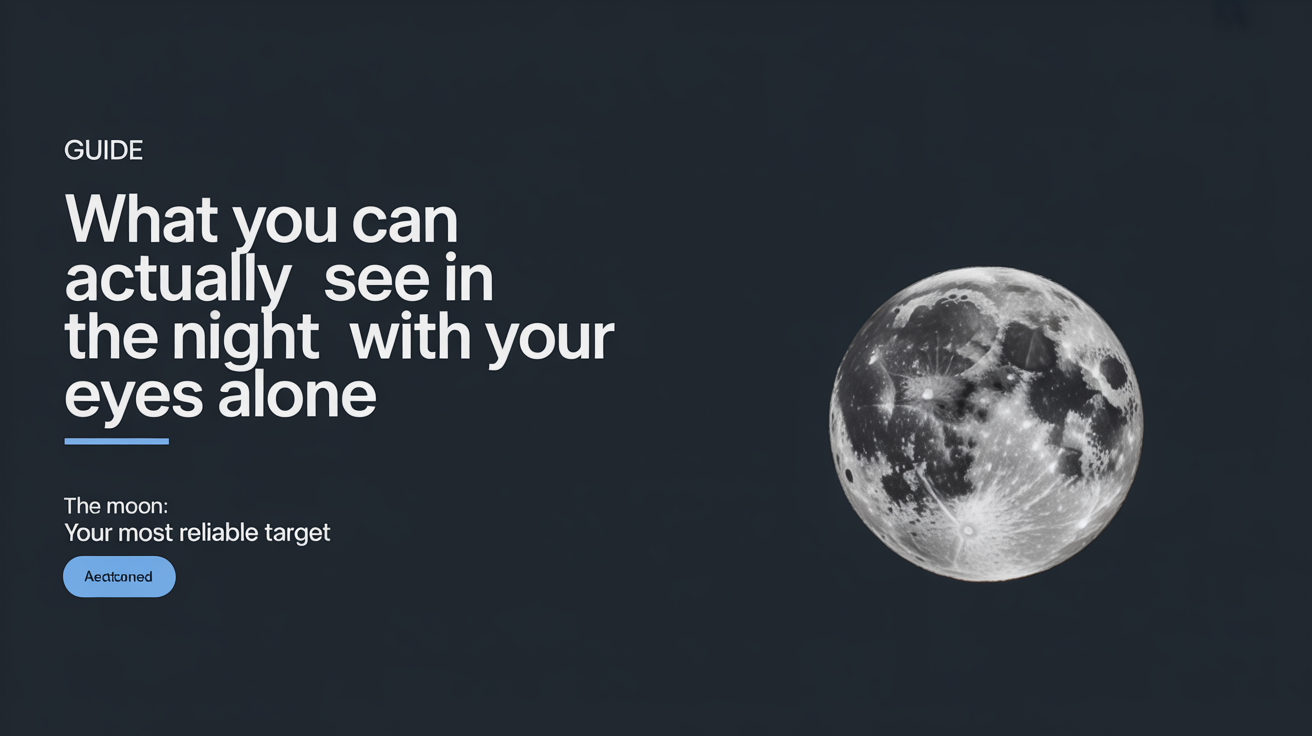
The Moon is the first thing most people look at, and for good reason. It's bright enough to see in daylight, shows obvious phase changes over the course of a month, and rewards attention even without optical aid.
The four main phases take about 29.5 days to cycle:
- New Moon, not visible; the dark side faces Earth. This is the best time for deep-sky viewing.
- Waxing crescent and first quarter, the lit portion grows through the first half of the month.
- Full Moon, fully lit and brilliant, but it washes out fainter targets nearby.
- Waning gibbous through third quarter, the lit side shrinks toward the next new Moon.
One detail many beginners miss: the terminator line (the boundary between light and shadow on the lunar surface) is where surface detail is most dramatic. Craters and mountain ranges cast long shadows there. Along the fully lit limb, everything looks flat.
The Five Naked-Eye Planets
Venus, Jupiter, Mars, Saturn, and Mercury are all visible to the unaided eye and have been tracked by observers for thousands of years. The key to identifying them is simple: planets don't twinkle. Stars scintillate because they're point sources, and Earth's atmosphere blurs them. Planets subtend a small but real disk, so the atmospheric blur averages out and they shine with a steadier light.
Here's how to tell them apart:
- Venus is the brightest object in the night sky after the Moon. It never strays far from the Sun, so you'll find it in the west after sunset or the east before sunrise. At peak brightness it can be seen in broad daylight if you know exactly where to look.
- Jupiter is the second-brightest planet and holds a steady cream-white color. When it's up, it's hard to miss.
- Mars glows distinctly orange-red, though its brightness varies a lot, at opposition it can rival Jupiter; at its faintest, it's an unimpressive reddish dot.
- Saturn shines with a pale gold light. Through even binoculars you can detect that something is off about its shape; the rings are resolved with even a cheap 30x telescope.
- Mercury is the tricky one. It stays within 28 degrees of the Sun and is only visible in twilight, low on the horizon. Catching it is satisfying specifically because most people have never bothered.
Stars and Constellations Worth Knowing
There are roughly 5,000–6,000 stars visible to the unaided eye under ideal conditions; from a typical suburban backyard, more like 2,000–3,000. Learning to navigate them takes time, but a few landmarks help enormously. The star chart basics guide covers the mechanics; here are the anchors worth spotting first.
Bright stars with distinct colors:
- Sirius (blue-white, the brightest star in the sky)
- Betelgeuse (orange-red, upper-left shoulder of Orion)
- Rigel (blue-white, lower-right foot of Orion)
- Arcturus (warm orange, high in the spring and summer sky)
- Vega (pure blue-white, nearly overhead in summer from mid-latitudes)
- Antares (distinctly red, heart of Scorpius)
Constellations that are actually useful as signposts:
- Orion anchors the winter sky and points toward Sirius and the Pleiades
- The Big Dipper (part of Ursa Major) points to Polaris and to Leo
- Cassiopeia, on the opposite side of Polaris from the Dipper, is a W-shape easy to pick out year-round
The Pleiades, the Orion Nebula, and the Milky Way
Naked eye astronomy goes beyond single stars once you know where to look.
The Pleiades (M45) look like a small smudgy cluster to casual observers. Under good skies, most people can resolve 6 stars; people with sharp vision pick out 7 or 8. The cluster is real, about 800 light-years away, and is one of the easiest deep-sky objects to find because it's bright and obvious in winter skies, just northwest of Orion.
The Orion Nebula (M42) sits in the middle of Orion's "sword," the short line of stars hanging below his belt. Under reasonably dark skies it's a fuzzy patch rather than a point, even to the naked eye. Binoculars reveal it clearly; it's a star-forming region about 1,300 light-years out.
The Milky Way is the band of our own galaxy seen edge-on. From a Bortle 3 or darker site, it stretches completely across the sky from horizon to horizon, with obvious dark dust lanes and bright knots of stars. The core (brightest section) rises in the south during northern hemisphere summer. From suburban skies it's faint or absent, getting to a genuinely dark site for the first time is one of those experiences that resets your sense of scale.
The Andromeda Galaxy (M31) is the most distant object most people will ever see with their eyes alone: 2.5 million light-years away. It shows as an oval smudge in Andromeda, slightly larger than a full Moon on the sky. You need dark skies and to know exactly where to look, but there's something specific about knowing you're seeing that light unaided.
Things to See at Night Sky That Surprise Newcomers
Beyond the catalog objects, several transient things to see at night sky catch observers off guard:
Meteors are visible on any clear night, background rate is maybe 5–10 per hour. During meteor showers (Perseids peak in mid-August, Geminids in mid-December), rates can hit 50–100 per hour from a dark site. You don't need equipment; you just need a reclining chair, a sleeping bag, and patience.
The International Space Station passes over most of Earth every few days, moving fast and bright (sometimes magnitude -3) across the sky in a few minutes. Apps like Heavens-Above or NASA's Spot the Station give exact times and paths. There are also other satellites, you'll see a steady-moving point of light fairly often once you're watching for them.
Comets and auroras are genuinely irregular. A bright comet visible to the naked eye is rare (a few per decade); when one appears it's real news. Auroras (northern or southern lights) depend on solar activity and magnetic latitude. If you live above about 50° north, a strong geomagnetic storm will occasionally put green or red curtains across the sky.
If you're just getting started, the complete beginner's guide to stargazing covers where to find dark skies and how to plan your first sessions around what's currently up.
Frequently Asked Questions
How many stars can you actually see with the naked eye?
Under a dark, moonless sky (Bortle 2–3), a person with normal vision can see roughly 4,000–5,000 stars at any one time. Over a full year (the whole celestial sphere), about 9,000–10,000 stars are technically within reach of the human eye. From a typical suburban backyard, the number drops to 1,000–2,000 on a good night.
Can you see the Milky Way from the suburbs?
Rarely, and not well. The Milky Way requires skies significantly darker than most urban or suburban environments offer. To see it clearly you need a Bortle 4 or darker site, which usually means driving at least 30–60 miles from a major city. Light pollution maps (like lightpollutionmap.info) show you where the dark zones are.
How do I tell a planet from a star?
The reliable test is the twinkle test: planets shine steadily and stars twinkle (scintillate), especially near the horizon. Planets are also confined to a band across the sky called the ecliptic, since they all orbit roughly in the same plane as Earth. If you see a bright, steady, non-twinkling object along that band, it's almost certainly a planet.
What's the best time of year for naked eye astronomy?
Any season has something worth seeing, but clear, dry nights tend to be more common in summer and autumn. Winter is excellent for bright stars (Orion dominates) but cold temperatures shorten sessions. Summer gives you the Milky Way core, the Perseids in August, and warm nights to sit outside. The Moon's phase matters more than the season, plan around new Moon for the faintest targets.
Do I really need 30 minutes for my eyes to dark-adapt?
Yes. Your eyes have two types of photoreceptors, cones (used in daylight) and rods (used in dim light). Rods need time to become sensitive after bright light exposure, and full adaptation takes 20–30 minutes. Even a brief glimpse of white light (a phone, a car headlight) resets the process partially. Red lights don't trigger the reset, which is why astronomers use red flashlights when reading charts.