Getting Started
How to Start Stargazing: A Complete Beginner's Guide
Learn how to start stargazing with no equipment, no experience, and no jargon. A practical guide for absolute beginners getting into amateur astronomy.
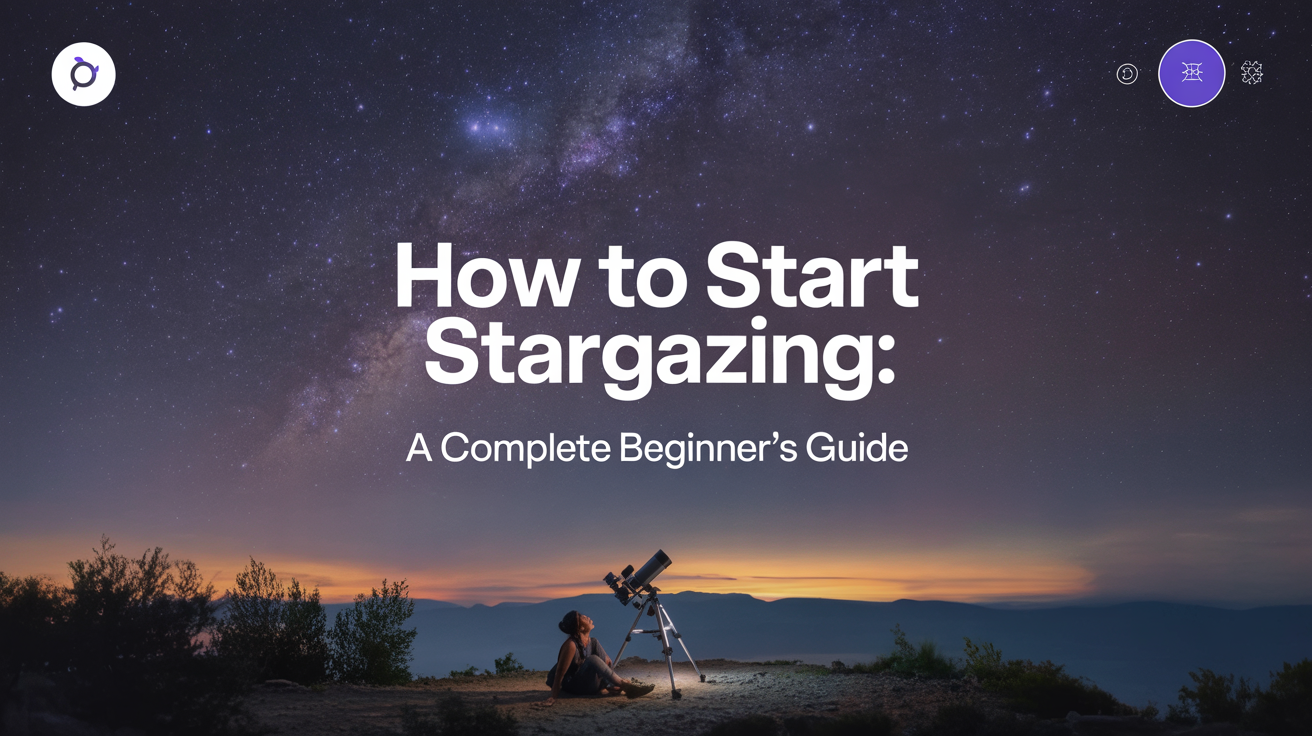
Step outside on a clear night, let your eyes adjust, and look up. You don't need a telescope, an astronomy degree, or expensive gear to start stargazing. A reasonably dark sky and twenty minutes of patience will show you more than most people ever bother to look for.
This guide covers everything a complete beginner needs to get started: what you can see with the naked eye, how your eyes actually work in the dark, which tools help (and which are overkill at first), and how to find your way around a sky that, admittedly, can look overwhelming when you don't know where to begin.
What You Can See Before You Buy Anything
Most people assume stargazing requires a telescope. It doesn't, at least not at first. Your unaided eyes are a perfectly good instrument, and learning to use them well is the foundation of amateur astronomy for beginners.
On any clear night, you can see:
- The Moon in detail, including the rough outlines of its maria (dark basaltic plains) and bright highland regions
- Planets, Venus and Jupiter are often the brightest objects in the sky after the Moon; Saturn has a distinctive steady glow; Mars turns distinctly orange-red during close approaches
- Star clusters like the Pleiades (the tight little dipper-shaped cluster in Taurus) and the Beehive Cluster in Cancer, both visible to the naked eye as hazy patches
- The Milky Way as a soft, irregular band across the sky, but only from a dark site, which we'll get to
- Meteor showers during reliable annual events like the Perseids in August or the Geminids in December
See the full rundown of what you can actually see with your eyes alone before you decide whether you need more equipment.
Dark Adaptation: The Most Important Thing Nobody Mentions
Before you dismiss a site as "too faint to see anything," give your eyes time to adapt. This is called dark adaptation, and it's genuinely the single biggest improvement you can make without spending a penny.
When you walk from a lit room into the dark, your eyes start producing rhodopsin, the photosensitive pigment in your retinal rods. Full dark adaptation takes about 20 to 30 minutes. Skip this step and you'll see maybe 10% of what's actually there.
Two things destroy dark adaptation almost instantly:
- White light, looking at your phone screen, a car's headlights, or even a regular flashlight will reset the process
- Blue-spectrum light, this is the worst offender; it bleaches rhodopsin faster than other wavelengths
The fix is simple: use a red flashlight. Red light preserves your dark adaptation while still letting you read a star chart or check your notes. You can buy a dedicated red flashlight for a few dollars, or just tape some red cellophane over a regular one. Serious observers use red-filtered headlamps so their hands stay free.
Read more about dark adaptation and how to train your eyes to see more stars for the deeper explanation of why this works.
Finding a Dark Sky (and Why It Matters)
Light pollution is the biggest obstacle for most beginners. If you live in or near a city, the orange glow washing out your sky is skyglow, scattered light from streetlights, buildings, and cars bouncing off atmospheric particles.
Astronomers use the Bortle scale (1–9) to describe sky darkness:
| Bortle Class | Sky Description | What You Can See |
|---|---|---|
| 1–2 | Truly dark rural | Zodiacal light, Milky Way casting shadows, thousands of stars |
| 3–4 | Rural to suburban transition | Milky Way clearly visible, most deep-sky objects accessible |
| 5–6 | Suburban | Milky Way visible but washed out; brighter clusters and nebulae accessible |
| 7–8 | Urban fringe | Moon, planets, brightest star clusters; Milky Way barely a hint |
| 9 | Inner city | Moon, planets, perhaps 200–300 stars at best |
Most beginners are working in Bortle 7–8 territory. That's fine for the Moon, planets, and the brightest naked-eye objects, you don't need to drive two hours into the desert for your first session. But if you want to see the Milky Way or fainter deep-sky objects, a dark-sky site makes an enormous difference.
Check the Light Pollution Map to find your nearest Bortle class and see how far you'd need to drive for darker skies. Many beginners find a Bortle 4–5 site within 30–60 minutes of a mid-sized city.
Binoculars First, Telescope Second
If you want to buy some equipment, start with binoculars. A good pair of 7×50 or 10×50 binoculars (the numbers are magnification × aperture in mm) will show you crater fields on the Moon, the four Galilean moons of Jupiter, the Orion Nebula (M42) as a distinct fuzzy patch, and hundreds of stars in the Pleiades.
Binoculars have real advantages over a beginner telescope:
- They give you a wide field of view, which makes finding objects much easier
- No setup time, you're observing 30 seconds after going outside
- They work great for daytime use too
- A decent pair costs $50–$150 and outperforms a shaky $80 department-store telescope every time
A telescope becomes worth it once you know what you're looking for. A good starter telescope, something like a 6-inch Dobsonian reflector, will show you Saturn's rings clearly, Jupiter's cloud bands, the Orion Nebula's glowing gas cloud, and globular clusters like M13. But they take time to learn to use, require collimation (optical alignment), and a shaky cheap mount ruins the experience entirely.
If you do go the telescope route, prioritize aperture (mirror or lens diameter) and mount stability over magnification. High magnification is nearly useless on a wobbly tripod.
Learning the Sky: Apps, Charts, and Actual Memorization
This is where a lot of beginners get stuck. The sky is full of stars and it's not obvious how to find anything.
Use a Free App to Get Started
Stellarium (free, available for desktop and mobile) is the go-to recommendation. Point your phone at the sky and it overlays constellation lines, planet names, and object labels in real time. There's also SkySafari, which has more depth for observers who advance quickly.
One word of caution: apps are useful training wheels, but staring at a bright screen kills your dark adaptation. Use your phone briefly, then switch off and observe. Better yet, use the red-night-mode setting most astronomy apps include.
Learn a Few Constellations First
Don't try to memorize the whole sky at once. Pick three or four constellations visible in your current season and learn them well. In the northern hemisphere, the Big Dipper (part of Ursa Major) is visible year-round and serves as a navigation anchor, follow the two "pointer stars" at the end of its bowl and you'll find Polaris, the North Star, every time.
From there you can star-hop: use known bright stars as stepping stones to find fainter targets nearby. This is how experienced observers navigate the sky, and it's much more satisfying than relying on a GPS-guided mount.
Learn how to read a star chart and find your way around the sky once you've had a few sessions outside.
A Few Landmark Objects Worth Hunting Early On
- The Orion Nebula (M42): The faint smudge in Orion's sword, visible naked-eye, spectacular in binoculars
- The Pleiades: A tight cluster in Taurus; most people can see 6–7 stars naked-eye; binoculars reveal dozens
- Saturn: Even a small telescope shows the rings clearly, it's genuinely astonishing the first time
- The Andromeda Galaxy (M31): The farthest object visible to the naked eye, appearing as a faint elongated smudge near the Andromeda constellation
Building a Simple Routine
Getting into astronomy consistently is mostly about habit. A few practical suggestions:
Check the weather and Moon phase first. A full Moon is gorgeous but it washes out fainter objects. New Moon weeks (when the Moon rises and sets with the Sun) give you the darkest skies. Sites like Clear Outside or Weather Underground's astronomy section give cloud cover forecasts by the hour.
Dress warmer than you think you need to. Standing still outside at night, even in summer, gets cold surprisingly fast. Experienced observers almost always overdress.
Give yourself a single goal per session. "I'm going to find the Orion Nebula tonight" is more satisfying than aimlessly scanning. Once you've found it, take your time actually looking, the eye picks up more detail the longer it dwells on a faint object.
Keep notes. A small notebook with date, time, location, sky conditions, and what you saw builds a record you'll actually enjoy looking back on. It also helps you notice patterns, which objects are best in which months, how much difference a dark site makes.
Frequently Asked Questions
Do I need a telescope to start stargazing?
No. Your naked eyes are the right tool to start with, and binoculars are a worthwhile upgrade before a telescope. Many experienced amateur astronomers spend most of their time observing naked-eye or with binoculars.
How long does it take for eyes to adapt to the dark?
Full dark adaptation takes around 20 to 30 minutes. Even five minutes helps significantly. Avoid white light during this time, use a red flashlight if you need to see anything.
What's the best free app for stargazing beginners?
Stellarium is the most widely recommended free option. It's accurate, well-maintained, and available on both desktop and mobile. Enable the red-night mode before you go outside.
Can I stargaze from my backyard in the suburbs?
Yes, with realistic expectations. The Moon, planets, and the brightest star clusters are all accessible from suburban skies. You won't see the Milky Way, but you can still have productive, enjoyable sessions. A drive to a Bortle 4 site occasionally will show you what a truly dark sky looks like.
Is it safe to look at the Sun through binoculars or a telescope?
Never look at the Sun through binoculars, a telescope, or any optical instrument without a proper solar filter rated for astronomy use. Unfiltered solar viewing causes permanent, irreversible eye damage in seconds. Purpose-built solar filters (like those made from Baader AstroSolar film) make solar observation completely safe and genuinely interesting, but improvised filters like smoked glass or CDs are not safe and should not be used.