Telescopes & Gear
How to Choose Your First Telescope: A Beginner's Buying Guide
Learn how to choose a telescope that actually works for you. Covers aperture, mount types, scope designs, and what to avoid as a first-time buyer.
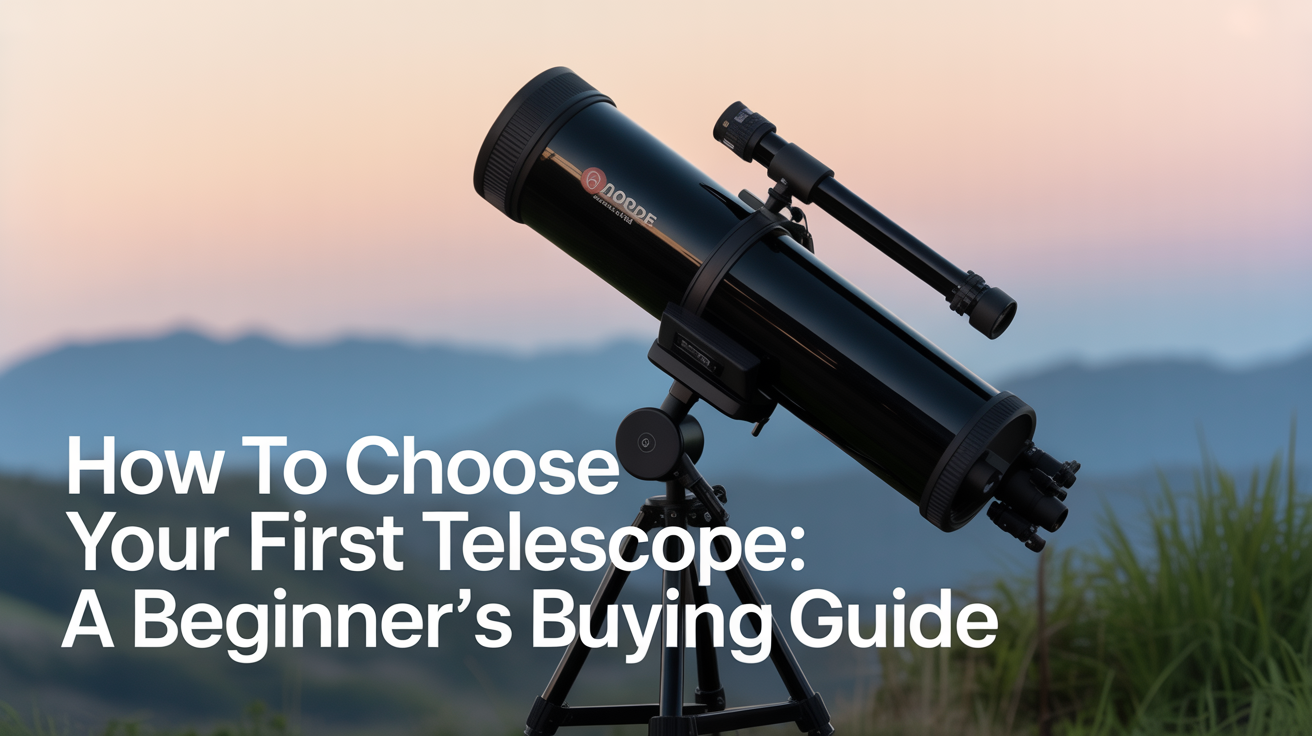
Picking your first telescope is easier to get wrong than right. Walk into a big-box store, buy the shiny box that promises "500x zoom," and you'll spend one frustrating night squinting at a blurry moon before the scope goes into a closet. That's not a made-up scenario; it happens constantly. The good news is that once you know what to look for, the right choice becomes obvious.
This guide cuts through the marketing noise and explains the things that actually determine whether a telescope will serve you well: aperture, optical design, mount, and realistic expectations about what different instruments can show you.
Start Here: Aperture Is the Number That Matters Most
Before you read another spec on a box or website, understand this: aperture (the diameter of the main lens or mirror) is the single most important number in a telescope. It determines how much light the scope gathers, which dictates how faint an object you can see and how sharp the image will be.
Magnification, by contrast, is cheap and mostly irrelevant. Any telescope can be made to magnify more by swapping in a shorter eyepiece, but you can't manufacture light-gathering ability that isn't there. A 60mm scope magnified to 200x will show you a dim, mushy blur. A 200mm scope at the same magnification will show you something real.
Here's a quick breakdown of what different aperture ranges realistically reveal:
| Aperture | What You'll See Well |
|---|---|
| 60–70mm | Moon, Saturn's rings (barely), Jupiter's disk |
| 80–90mm | Moon in detail, Jupiter's cloud bands, double stars |
| 100–114mm | Brighter deep-sky objects (Orion Nebula, Pleiades), Saturn's Cassini Division |
| 150–160mm | Globular clusters, nebulae, Mars surface features in opposition |
| 200mm+ | Faint galaxies, planetary detail, rich star fields |
If you're shopping in the beginner range, 100mm or larger is the threshold where the sky really starts to open up. Below that, you're mostly limited to the moon, planets, and bright star clusters.
For a deeper look at how aperture and magnification interact (and why "500x" claims are almost always meaningless), see our guide on aperture vs. magnification and what actually matters in a telescope.
The Three Main Telescope Designs
Every beginner telescope fits into one of three optical designs. Each has genuine strengths, and understanding the differences will save you from buying something that doesn't match how you want to use it.
Refractors
A refractor uses a lens at the front to focus light. These are the classic "spy glass" style scopes. They're typically compact, require no collimation (alignment), and are great for the moon, planets, and terrestrial viewing. The optics are sealed inside the tube, so they stay clean and stable.
The catch: quality glass is expensive, and refractors above about 100mm aperture get long, heavy, and costly. The best beginner refractors sit in the 70–90mm range. They're excellent grab-and-go scopes but won't show you much beyond the bright showpieces.
Reflectors (Newtonian)
A reflector uses mirrors instead of lenses, which lets manufacturers build much larger apertures without the same price jump. A 114mm or 130mm Newtonian reflector often costs less than a 70mm refractor from a reputable brand. The trade-off: the mirrors require occasional collimation (a simple process, but it's a step refractors skip), and the open tube can accumulate dust over time.
For pure aperture-per-dollar, a Newtonian reflector is hard to beat in the beginner range.
Dobsonians
A Dobsonian is technically still a Newtonian reflector, but it's mounted on a simple, intuitive rocker-box base that sits on the ground rather than a tripod. The design was popularized by amateur astronomer John Dobson specifically to make large apertures affordable and accessible.
An 8-inch (200mm) Dobsonian typically costs less than a much smaller refractor on a motorized mount. If your primary goal is seeing as much sky as possible for as little money as possible, a Dobsonian is almost always the right answer for a first telescope. They're not perfect for astrophotography, and pointing one at a precise coordinate takes practice, but for visual observing, nothing else comes close in the beginner price range.
For a full comparison of how these designs stack up, our guide on refractor, reflector, or Dobsonian telescope types explained goes into much more detail.
Telescope Mounts: The Part Everyone Ignores Until They Regret It
A wobbly, frustrating mount can ruin an otherwise good telescope. There are two main categories.
Alt-Az Mounts
Alt-az (altitude-azimuth) mounts move up-down and left-right. They're intuitive to use, especially for beginners. Simple alt-az mounts come standard on most entry-level refractors and small reflectors. Dobsonians use an alt-az rocker box. These are perfectly fine for visual observing.
Equatorial Mounts (EQ)
Equatorial mounts are tilted to match Earth's rotational axis, which lets you track objects by turning a single knob. They're useful for longer planetary sessions and essential for astrophotography. However, they're more complex to set up and require polar alignment, which can be confusing at first.
Here's the trap many beginners fall into: buying a small-aperture scope with a fancy computerized equatorial mount. The mount costs more than the optics, and you end up with a 70mm computerized telescope that can find objects automatically but can't show you anything worth seeing. A manual 6-inch Dobsonian will serve you far better.
What to Avoid: Red Flags When Buying a First Telescope
Knowing what to skip is half the battle with a first telescope buying guide.
Department-store "power" scopes. If the box prominently advertises magnification (especially anything above 300x) without mentioning aperture in millimeters, walk away. These scopes are almost always poorly made 60mm refractors with cheap plastic eyepieces. The optics rarely hold alignment, the mounts shake in a light breeze, and the high magnification just makes a bad image bigger.
Zoom eyepieces bundled as a selling point. A single good Plössl eyepiece at a useful focal length is worth more than five cheap zoom eyepieces.
Tiny tripod with a heavy scope. If the mount looks spindly for the size of the optical tube, the whole setup will vibrate every time you touch it. Check reviews specifically for mount stability.
Promised apertures in inches without metric equivalents. "3-inch" sounds reasonable; 76mm is close to the bare minimum for useful observing. Reputable brands list both.
Focal Length and Focal Ratio: What They Tell You
Every telescope specification includes a focal length (in millimeters) and a focal ratio (f/number). These matter for how you use the scope.
A longer focal length at a high f/number (f/10, f/12) means higher magnification at a given eyepiece and a narrower field of view. These scopes excel at planetary observing and tight double stars. A shorter focal length at a low f/number (f/4, f/6) gives you a wider, brighter field, which is better for sweeping star clusters and nebulae.
Most beginner Newtonians and Dobsonians sit around f/6 to f/8, which is a practical middle ground. Short focal-ratio refractors (f/5 or below) can produce chromatic aberration (color fringing) unless they use specialty glass, so beginners should generally look for f/7 or higher in a refractor.
Should You Start With Binoculars Instead?
Genuinely consider it. A good pair of 10x50 or 7x50 binoculars will show you the moon's craters, the Orion Nebula, Jupiter and its four Galilean moons, hundreds of star clusters, and the Milky Way in a way that no entry-level department-store telescope can match. They're portable, require zero setup, and work just as well for hiking or birdwatching.
If you're not sure whether you'll stick with the hobby, binoculars are a low-risk starting point. Many experienced astronomers still reach for binoculars first on any given night. We've written more about this in our guide on why binoculars are the best first tool for stargazing.
That said, if you're already certain you want a telescope and you know you'll use it regularly, skip straight to a quality beginner scope. Don't buy cheap binoculars AND a cheap telescope trying to cover both bases on a tight budget.
Putting It Together: What to Actually Buy
Here's a practical summary based on different goals:
Best overall first telescope for most beginners: A 6-inch (150mm) or 8-inch (200mm) Dobsonian. Brands like Orion and Sky-Watcher have well-regarded options in this category. You'll see galaxies, globular clusters, nebulae, and detailed planetary views.
Best portable first telescope: A 90mm or 100mm refractor on a sturdy alt-az mount. Lighter and easier to set up than a large Dobsonian, though you sacrifice aperture.
Best for a child or casual user: A 114mm Newtonian on a simple alt-az mount keeps the price low and the setup easy. Aperture is still adequate for the moon and bright planets.
Best if astrophotography is the eventual goal: Consider a 130mm or 150mm reflector on a motorized equatorial mount. The mount will be more important than the optics for photography, but you'll want to understand the basics of visual astronomy first.
Whatever you choose, buy from a dedicated astronomy retailer (online or local) rather than a general merchandise store. The optics and build quality difference is significant, and you'll have access to better support.
Frequently Asked Questions
How much should I spend on a first telescope?
A beginner scope that will genuinely satisfy you typically starts around $150–$250 for a decent 114mm Newtonian or Dobsonian. Anything much cheaper usually has compromised optics or a shaky mount. There's no upper ceiling, but you don't need to spend more than $400–$500 to get a telescope that will serve you well for years.
Is a computerized (GoTo) telescope worth it for a beginner?
It depends on how you learn. GoTo mounts find objects automatically once aligned, which can reduce frustration when you can't identify what you're looking at. The downside is cost and complexity: the mount adds significant expense that would be better spent on aperture, and learning the sky manually builds a deeper understanding of what you're observing. Most experienced amateurs recommend learning the sky manually first, then adding GoTo capability later if you want it.
Can I see galaxies with a beginner telescope?
Yes, with limitations. With 150mm or more of aperture under reasonably dark skies, you can see dozens of galaxies as fuzzy patches or elongated glows. You won't see the Hubble-style color spiral images; those require long-exposure photography. But knowing you're seeing actual light that left a galaxy 50 million years ago is its own kind of extraordinary.
What eyepieces should I buy?
Most beginner telescopes come with one or two eyepieces that are adequate to start. If you want to add one, a 25mm Plössl gives you a wide, low-power view good for finding objects and viewing clusters. A 10mm or 12mm Plössl gives you medium power for planets. Avoid very short eyepieces (under 6mm) until you understand your scope's limits.
Does light pollution affect what I can see with a telescope?
Significantly. The moon and planets are largely unaffected by light pollution, but nebulae and galaxies wash out badly under bright suburban or urban skies. A beginner telescope will show you far more from a dark site than from a city backyard, but even under moderate light pollution, the moon, Jupiter, Saturn, and double stars remain satisfying targets.