Telescopes & Gear
Refractor, Reflector, or Dobsonian: Telescope Types Explained
Refractor, reflector, Dobsonian, or compound scope? Learn how each type of telescope works and which suits your goals and budget.
Walk into any astronomy shop or online forum and you'll quickly run into a wall of acronyms: refractor, Newtonian, Dobsonian, SCT, Mak. These are not just brand categories. They describe fundamentally different optical designs, and picking the wrong one for your goals can leave you frustrated with a scope that sits in the closet. This guide breaks down the four main types of telescopes, explains what each one does well, and helps you figure out which fits where you're starting from.
At a Glance
- Refractors use a lens, reflectors and Dobsonians use a mirror, and compound scopes use both; the optical design drives cost, maintenance, and what each scope is best at.
- Reflectors and Dobsonians deliver the most aperture per dollar because mirrors are cheaper to manufacture at high precision than equivalent glass lenses.
- Refractors need essentially zero maintenance and give sharp, high-contrast views; reflectors need occasional collimation (mirror alignment), which takes 5 to 10 minutes once you've learned it.
- A Dobsonian is just a Newtonian reflector on a simple manual rocker-box mount, not a different optical design.
- Compound scopes (SCTs and Maks) pack a long focal length into a short tube, trading portability for a longer cooldown time before views sharpen.
- NASA's overview of telescope optics confirms the core tradeoff: lenses bend light but get heavy and expensive at large sizes, while mirrors scale to large apertures far more easily, which is why nearly every large research telescope today is a reflector.
How Light Gets to Your Eye: The Core Difference
Every telescope has one job: collect light and focus it so your eye (or a camera sensor) can see faint, distant objects in detail. The designs differ in how they do that collecting and focusing.
Refractors use a glass objective lens at the front of the tube. Light passes through the lens, bends (refracts), and converges at a focal point near the eyepiece. This is the design most people picture when they think "telescope." As NASA's telescope primer explains it, a lens works the same way eyeglasses do, bending light so it converges, but large lenses become heavy and thick enough that they start blocking some of the very light they're supposed to gather.
Reflectors use a curved mirror at the back of the tube instead of a lens. Light travels down the open tube, hits the primary mirror, bounces back up toward a secondary mirror, and then gets redirected to the eyepiece on the side of the tube. No glass for light to pass through means no chromatic aberration by design. Mirrors also solve the weight problem inherent to lenses: a bigger mirror doesn't need to be proportionally thicker the way a bigger lens does, which is a major reason nearly every large observatory and space telescope built in the last century uses mirrors rather than lenses.
Dobsonians are a subtype of Newtonian reflector, not a separate optical design. The distinction is the mount: a Dobsonian sits on a simple wooden or particleboard rocker-box base that pivots up-down (altitude) and left-right (azimuth). The optics inside are standard Newtonian mirrors.
Compound scopes (Schmidt-Cassegrains and Maksutov-Cassegrains) fold the light path inside a sealed tube using both mirrors and a corrector lens at the front. The result is a long focal length packed into a short, portable tube.
Understanding these differences makes everything else click. As you dig deeper into gear choices, it also helps to read up on aperture vs magnification, because aperture is the single most important spec regardless of which design you choose.
Refractors: The Classic Choice
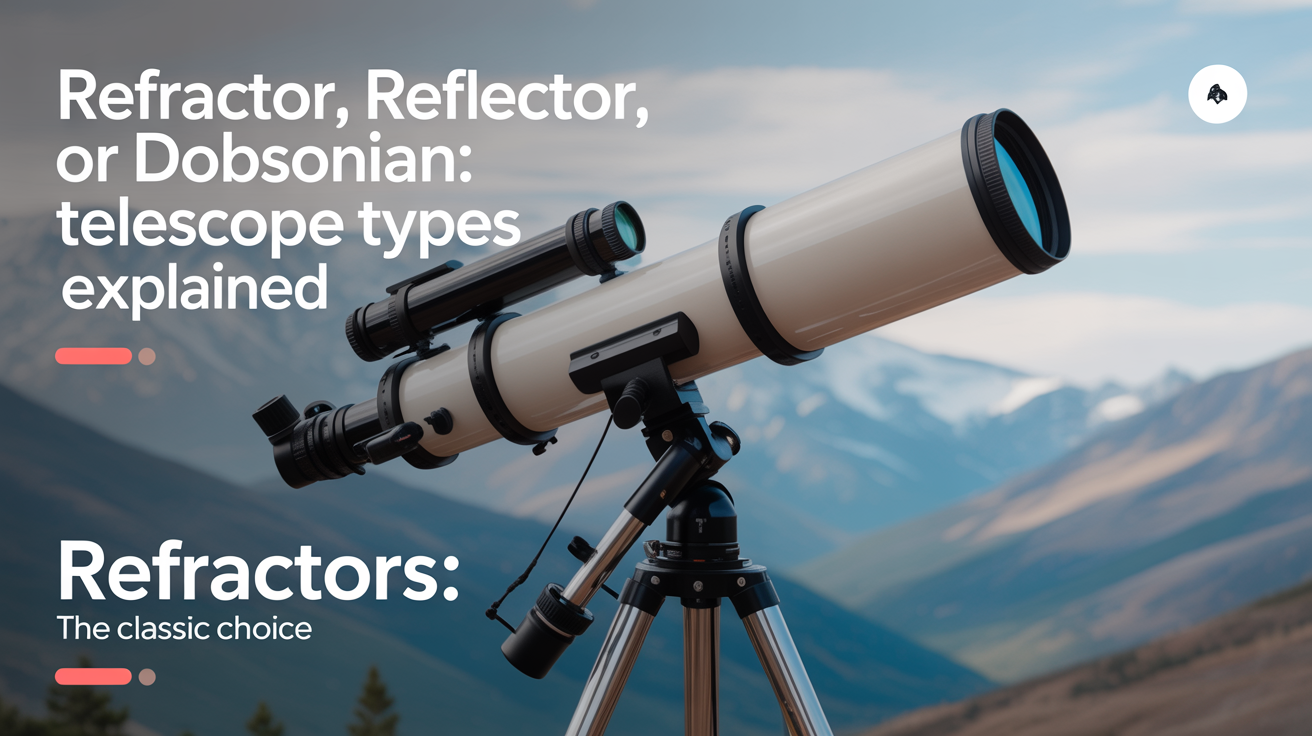
Refractors are sealed, low-maintenance instruments. Because there are no mirrors to knock out of alignment and no open tube to let in stray air currents, they produce consistently sharp, high-contrast views. Point one at the Moon or Saturn and you'll see why planetary observers have favored them for centuries.
What they're good at
- The Moon and planets. A quality refractor delivers crisp, contrasty views of lunar craters and planetary detail. The sealed tube means the optics thermally stabilize quickly and aren't disrupted by internal air currents.
- Double stars. Their diffraction pattern tends to be clean, making tight doubles easy to split.
- Low-maintenance use. Collimation (mirror alignment) is not a concern. Point and look.
Where they fall short
Aperture per dollar is poor. Glass is expensive to grind to the precision required for astronomy, so a refractor with 4 inches of aperture costs significantly more than a reflector or Dobsonian with the same aperture. This matters because aperture drives how much light you gather and therefore what you can actually see.
Cheap refractors suffer from chromatic aberration: a false color fringe (usually purple) around bright objects. This comes from the lens bending different wavelengths of light by slightly different amounts, since no simple glass lens focuses every color to exactly the same point. Better "apochromatic" (APO) refractors use multiple lens elements and special low-dispersion glass to correct this, but they are expensive, often several times the price of an achromatic (non-APO) refractor of the same aperture. If you're considering a budget refractor in the 60–70mm range, temper your expectations; the fringing is usually mild on the Moon and bright planets but noticeable on high-contrast targets like Jupiter's cloud bands.
Reflectors: The Most Aperture per Dollar
A Newtonian reflector gives you the most light-gathering area for the money, full stop. The primary mirror is cheaper to manufacture to high precision than an equivalent objective lens, so a 6-inch or 8-inch reflector is accessible to most hobbyist budgets. As a rough benchmark, an 8-inch (200mm) Newtonian typically costs a fraction of what an 8-inch APO refractor would (if you could even find one; APO refractors that large are rare and largely custom-built), which is the whole economic case for choosing a mirror-based design.
What they're good at
Reflectors excel at deep-sky objects: galaxies, nebulae, star clusters. These objects are faint and spread across area, so raw aperture matters more than anything else. A well-made 6-inch Newtonian will show you structure in the Orion Nebula that a small refractor can only hint at.
The maintenance tradeoff
Mirrors need collimation periodically. This means adjusting the secondary and primary mirrors so they're precisely aligned. It sounds intimidating but takes 5–10 minutes once you've done it a few times, and there are cheap laser collimators that make it straightforward. Most owners check collimation before every serious session and only need to make small adjustments; a scope that's been transported carefully might hold collimation for weeks.
The open tube also means dust gets in over time, and the mirrors may need cleaning every few years. This is less involved than it sounds, but it's real ongoing care that a refractor doesn't require.
What Is a Dobsonian Telescope?
A Dobsonian is a Newtonian reflector mounted on a rocker-box base, originally popularized by amateur astronomer John Dobson in the 1970s. His goal was to make large apertures affordable and portable enough for community sidewalk astronomy. He succeeded.
The rocker-box mount is elegantly simple. You push the tube up or down and swing it left or right. No motors, no counterweights, no polar alignment. The tradeoff is that it's a purely manual mount: once you find an object, the Earth's rotation will drift it out of view in minutes, so you nudge the scope periodically to track it. At higher magnifications on a small Dobsonian, that drift can mean nudging the tube every 30 to 60 seconds; at low power on a wide field, you might go several minutes between adjustments.
Why Dobsonians are the best telescope type for beginners who want deep-sky views
For the money, nothing else gets you as much aperture. An 8-inch Dobsonian sits at a price point that would buy you a 3-inch refractor or a modest compound scope. That extra aperture translates directly into fainter objects and more detail. You'll see the dust lanes in Andromeda, the Cassini Division in Saturn's rings, and the cloud bands on Jupiter.
The mount also teaches you the sky. Pushing a Dobsonian around manually forces you to learn star-hopping: navigating from bright stars to targets by memorizing patterns. It's slower than using a computerized mount, but the spatial knowledge sticks. If you're still at the "should I even buy a telescope" stage, it's worth reading why binoculars are the best first tool for stargazing before committing to any scope.
The downsides are size and tracking. A large-aperture Dobsonian is bulky. An 8-inch tube is roughly 4 feet long and requires a step stool at high elevations. And without a motor drive, astrophotography beyond the Moon and planets is impractical.
Compound Scopes (SCT and Maksutov): Compact but Specialized
Schmidt-Cassegrains (SCTs) and Maksutov-Cassegrains (Maks) fold a long focal path into a short tube by bouncing light between mirrors. An SCT with an 8-inch mirror and a 2,000mm focal length fits in a tube barely 18 inches long. That portability is real and genuinely useful for observers who travel to dark sites.
Both designs are popular for planetary and lunar observing and increasingly for astrophotography, because their long focal lengths deliver high magnification in a compact package. SCTs are more common in larger apertures; Maks are more common in smaller apertures with very long focal ratios that sharpen planetary detail.
Downsides to know
Compound scopes take longer to reach thermal equilibrium than open-tube Newtonians. On a cold night, you may wait 30–45 minutes before the views sharpen. The sealed tube can trap warm air initially, causing "mirror seeing" that wrecks fine detail until things settle. Some owners run a small fan behind the primary mirror to speed up cooldown, shaving perhaps 10 to 15 minutes off the wait.
They're also pricier per inch of aperture than Dobsonians, though the compact size and (often) included computerized mount offset that for many buyers.
Quick Comparison: Four Types Side by Side
| Type | Pros | Cons | Best for |
|---|---|---|---|
| Refractor | Low maintenance, sharp contrast, sealed tube | Expensive per inch, chromatic aberration in budget models | Moon, planets, double stars |
| Newtonian Reflector | Most aperture per dollar, no chromatic aberration | Needs periodic collimation, open tube | Deep-sky objects, planetary on larger apertures |
| Dobsonian | Huge aperture for the price, simple mount, easy to learn | Bulky, no motorized tracking, poor for astrophotography | Deep-sky visual observing, beginners on a budget |
| SCT / Mak | Compact, long focal length, often computerized | Slower thermal equilibration, higher cost per inch | Planets, Moon, astrophotography |
Cooldown and Setup Time by Type
Thermal equilibrium (letting the optics reach outdoor temperature) affects image sharpness more than most beginners expect. Here's roughly what to budget:
| Type | Typical cooldown | Setup time (experienced user) | Notes |
|---|---|---|---|
| Small refractor (under 4") | 10-15 min | 2-5 min | Sealed tube stabilizes fast |
| 6-8" Newtonian/Dobsonian | 20-30 min | 5-10 min | Open tube helps, but mirror mass takes time |
| 8" SCT | 30-45 min | 5-10 min (longer if aligning GoTo) | Sealed tube traps warm air initially |
| Large Dobsonian (10"+) | 30-45 min | 10-15 min | Thicker mirror, more thermal mass |
Choosing the Right Type for Your Situation
There's no universally best telescope type, but there are better fits for different goals.
You mostly want to look at the Moon and planets. A refractor (quality optics, 80mm or more) or a compound scope will serve you well. A smaller, sharp instrument beats a large one that's hard to collimate or takes an hour to cool down.
You want to see galaxies and nebulae visually. Get as much aperture as you can reasonably carry. A Dobsonian in the 8-inch range is the classic answer here. Even a 6-inch will reveal structure that a 3-inch can't approach.
You're not sure yet and want flexibility. A mid-sized Dobsonian is the most common first recommendation from experienced observers. It teaches the sky, handles a wide range of objects, and doesn't punish your budget badly if you discover you prefer binocular observing or visual doubles instead.
You want to photograph deep-sky objects. This changes the calculus considerably. Astrophotography favors equatorial mounts with accurate tracking, not Dobsonians. A detailed look at mount types and camera compatibility belongs in its own guide, but your optical tube choice matters less than your mount and tracking accuracy.
For a broader framework on evaluating your first purchase, the beginner's buying guide walks through budget tiers and what to expect at each.
Frequently Asked Questions
Is a Dobsonian the same as a reflector?
Yes and no. All Dobsonians are Newtonian reflectors, but not all Newtonians are Dobsonians. The optical design is identical: a parabolic primary mirror and a flat secondary. What makes it a Dobsonian is the rocker-box alt-azimuth mount, which is simpler and cheaper than an equatorial mount.
Do refractors need collimation?
Rarely, and in practice almost never for a quality sealed refractor. The lens elements are factory-aligned and stay that way. This is one of the practical appeals of the design for observers who don't want to fuss with maintenance.
Can I do astrophotography with a Dobsonian?
For lunar and planetary photography, yes. You can hold a phone to the eyepiece (afocal method) or use a camera adapter and capture sharp Moon and planet images. Long-exposure deep-sky photography is a different matter: without motorized tracking, stars trail in seconds at any meaningful focal length, making it impractical without significant modifications.
Which aperture is enough for a beginner?
Aperture is where the money goes, and more is almost always better in terms of what you can see. An 80mm (roughly 3-inch) refractor or a 114mm (4.5-inch) Newtonian are common entry points that show a respectable range of objects. An 8-inch Dobsonian is a significant step up. Under genuinely dark skies, the difference between 4 inches and 8 inches of aperture is dramatic.
What about GoTo computerized mounts?
GoTo mounts let you select an object from a hand controller and the scope slews to it automatically. They're genuinely useful, especially for observers who don't want to invest time in learning star-hopping. The tradeoff is cost and complexity. A GoTo mount that tracks accurately enough for visual use adds meaningful price to any scope. For visual observing, many experienced amateurs prefer learning the sky manually first and adding automation later.
Why do large research and space telescopes always use mirrors instead of lenses?
Because a lens can only be supported at its edge, a large one sags under its own weight and distorts the image, while a mirror can be supported from behind across its whole back surface. That structural limit is why, as NASA explains it, essentially every professional observatory instrument and space telescope built in the last century, including Hubble and the James Webb Space Telescope, uses mirrors rather than a giant lens. The same physics scales down: it's a big part of why an 8-inch mirror is affordable while an 8-inch lens of comparable quality would be a specialty item costing many times more.