Telescopes & Gear
Why Binoculars Are the Best First Tool for Stargazing
Binoculars for stargazing beat a beginner telescope every time. Learn why 10x50 binoculars are the smarter first buy and what you can actually see.
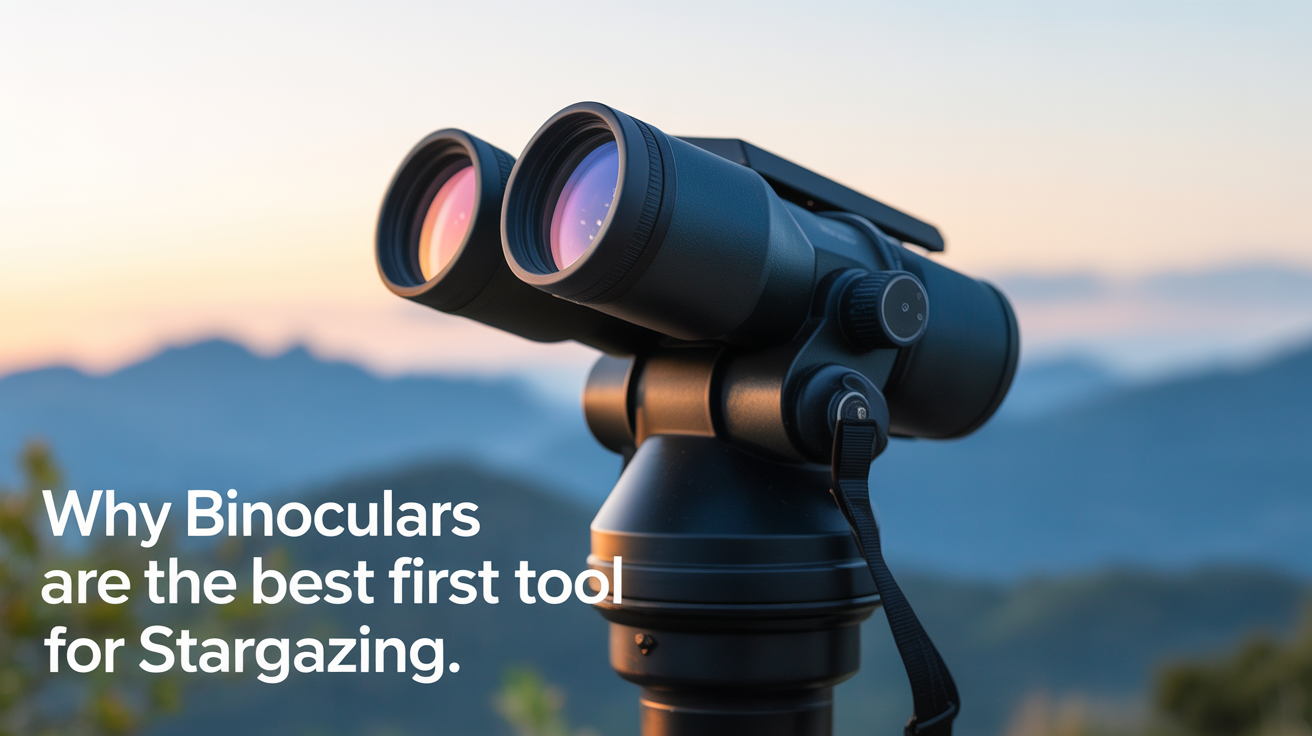
Pick up a pair of binoculars on a clear night and point them at the Milky Way. Within thirty seconds you'll see more stars than you thought existed. That experience, more than any spec sheet, is why binoculars belong in every stargazer's hands before a telescope does.
This isn't a knock on telescopes. A good scope is a wonderful thing. But as a first purchase, binoculars win almost every comparison that matters to a beginner: they're affordable, they work immediately, they show you a wide swath of sky, and you'll keep using them long after you own a telescope. If you've been wondering whether to start with binoculars for stargazing, the short answer is yes.
Understanding the Numbers: What 10x50 Actually Means
Every pair of binoculars has two numbers stamped on them, like 7x50 or 10x50. The first number is magnification. The second is the diameter of the front lenses (the objective lenses) in millimeters. A 10x50 binocular magnifies 10 times and has 50mm objectives.
For astronomy, aperture (that second number) matters most. Larger objectives gather more light, which directly translates to fainter stars you can detect.
Exit Pupil: The Number Manufacturers Don't Advertise Enough
Divide the aperture by the magnification and you get the exit pupil in millimeters. For a 10x50, that's 50 ÷ 10 = 5mm. For a 7x50, it's 50 ÷ 7 ≈ 7mm.
The exit pupil is the diameter of the light beam that enters your eye. Your dark-adapted eye can dilate to roughly 5–7mm depending on age (younger observers tend toward the higher end). A large exit pupil, like the 7mm from a 7x50, fills your fully dilated pupil and delivers maximum image brightness. A 5mm exit pupil from a 10x50 is still very good and suits people whose eyes don't dilate quite as wide.
The classic astronomy binoculars, 7x50 and 10x50, landed on those specs for exactly this reason. They give you meaningful magnification without shrinking the exit pupil so small that the image dims noticeably.
When to Consider Higher Magnification
Binoculars at 12x or 15x gather more detail on the Moon and tighter star clusters, but handheld shake becomes a real problem above roughly 10x. If you go that route, budget for a tripod or monopod. Handheld 7x and 10x binoculars are steady enough for most observers.
Binoculars vs Telescope: What the Comparison Actually Looks Like
A telescope's strength is magnification and detail on small targets: the rings of Saturn, the cloud bands of Jupiter, the craters of the Moon. Those things are genuinely better in a scope.
Everything else tilts toward binoculars for stargazing. A 7x50 or 10x50 delivers a field of view measured in degrees, often 5–7 degrees wide. Most beginner telescopes show you half a degree or less. That wide field makes finding objects possible without a star chart burned into memory. It also makes the experience enjoyable: you're looking at a landscape of stars, not a tiny porthole.
For context on how magnification and aperture interact when you do eventually move to a telescope, aperture vs magnification explained covers that trade-off in detail.
The other practical gap is setup time. Binoculars are out of the bag and focused in under a minute. A reflector or refractor needs to cool to ambient temperature (20–40 minutes on a winter night), and a Dobsonian needs collimation checks. None of that is hard, but it's a friction that keeps beginners inside on nights that are "pretty good but not perfect." Binoculars lower that barrier to zero.
What You Can Actually See
This is where binoculars surprise people. The list of targets is long and genuinely impressive.
The Moon is spectacular at 7x or 10x. You can see major crater fields, the terminator line where shadow sharpens the terrain, and the mare (dark lava plains) in enough detail to name them on a map.
The Pleiades (M45) are one of the first targets most astronomers try with binoculars. The cluster resolves from a fuzzy smudge into 50 or more individual stars, with several striking blue-white members clearly visible.
The Andromeda Galaxy (M31) stretches more than 3 degrees across in reality (six times the apparent width of the full Moon), and a wide-field binocular is the only handheld instrument that can frame most of it at once. In dark skies you'll see the core and two companion galaxies.
The Orion Nebula (M42) shows its nebulosity clearly, and the four stars of the Trapezium at its heart are resolvable in steady 10x binoculars.
Jupiter's moons are a genuine highlight. The four Galilean moons (Io, Europa, Ganymede, Callisto) are visible in most 10x50 binoculars as small dots arranged in a line on either side of the planet. Their positions shift night to night.
The Milky Way star clouds are arguably the best binocular target of all. Sweeping along the band of the galaxy in Sagittarius or Cygnus on a dark night is one of the experiences that turns casual sky-watchers into committed amateur astronomers.
Comets, when bright enough to observe at all, are almost always better objects in binoculars than telescopes. Their dust tails can span several degrees, and only a wide field shows that scale.
Open clusters throughout Cassiopeia, Perseus, and Puppis fill a binocular field beautifully, the kind of view that disappears into the eyepiece of a high-magnification scope.
Choosing the Right Binoculars for Astronomy
You don't need to spend a lot to get capable optics. The features that matter for astronomy are a bit different from birding or sports binoculars.
Aperture first. For a primary astronomy binocular, 50mm objectives are the practical sweet spot. Larger (70mm, 80mm) binoculars gather more light but get heavy fast; you'll want a tripod for anything over about 70mm.
Porro prism vs roof prism. Traditional-looking binoculars with offset barrels use porro prisms, which tend to deliver better optical quality at a given price point. The sleek straight-body designs use roof prisms, which are more compact but require tighter manufacturing tolerances to match porro quality. At entry and mid-range prices, porro-prism binoculars are generally the better astronomical choice.
Fully multi-coated optics. Coatings on each glass surface reduce light loss and glare. "Fully multi-coated" means every air-to-glass surface has multi-layer coatings, which gives you noticeably brighter, higher-contrast views compared to "coated" or "multi-coated" (partial coating).
Eye relief. If you wear glasses while observing, look for at least 15mm of eye relief so you can see the full field of view without pressing your lenses against the eyecups.
If you eventually want to understand the telescope that binoculars often lead people toward, refractor, reflector, or Dobsonian breaks down the main types. And choosing your first telescope walks through the buying decision when you're ready to take that step.
The Case for Binoculars Even After You Own a Telescope
Experienced observers routinely use binoculars alongside a telescope, not as a stepping stone but as a permanent tool. There are nights when the sky is partially cloudy and you want a quick look without dragging out the scope. There are targets (the full sweep of a comet, the Milky Way core) where the wide field of a binocular is simply the better view. And binoculars are what you grab when you're traveling and can't bring the scope.
The best astronomy binoculars you buy now will still be in active use in ten years. That's a different value calculation than a beginner telescope that many people outgrow quickly (or, discouragingly, sell because setup felt like too much work before the habit formed).
Start with binoculars. Learn the sky. You'll know exactly what telescope to buy, and why, when the time comes.
Frequently Asked Questions
Are regular binoculars good enough for astronomy, or do I need special ones?
Regular binoculars work fine if they have 40–50mm objectives and decent coatings. Sports and birding binoculars in the 8x42 to 10x50 range are used by plenty of astronomers. The main things to avoid are very small objectives (under 30mm) or very cheap optics with poor coatings, which produce dim, low-contrast views.
Is 10x50 or 7x50 better for stargazing?
Both are excellent. The 7x50 gives a larger exit pupil (about 7mm), which is ideal for fully dark-adapted eyes in very dark skies. The 10x50 gives slightly more magnification and is often more versatile because it's also useful for daytime activities. Most beginners find the 10x50 to be the more practical all-around choice.
Do I need a tripod for astronomy binoculars?
For 7x or 10x binoculars, a steady handhold is usually sufficient for casual observing, though mounting them on a tripod always improves the view, particularly on targets like Jupiter's moons where you're looking for detail. At 12x and above, a tripod or monopod becomes nearly essential because hand shake blurs the image noticeably.
Can binoculars replace a telescope for a beginner?
For the first year of stargazing, binoculars cover a surprising amount of ground. You can observe the Moon in detail, find dozens of deep-sky objects, and learn the constellations in a way that a telescope's narrow field doesn't support. They won't show Saturn's rings or resolve tight double stars the way a telescope does, but they build the sky knowledge that makes telescope use much more rewarding.
What's the cheapest aperture size worth buying for astronomy?
A 42mm or 50mm objective is the practical minimum for astronomy. Smaller than that and the exit pupil shrinks enough that faint objects become harder to pick out against the sky background. The difference between 30mm and 50mm binoculars on a dim galaxy or the Milky Way star clouds is immediately noticeable.