Sky This Month
How to Spot Satellites and the Space Station From Your Backyard
Learn how to see the ISS from your backyard, use pass-prediction tools, and tell satellites from planes. Includes Starlink train tips.
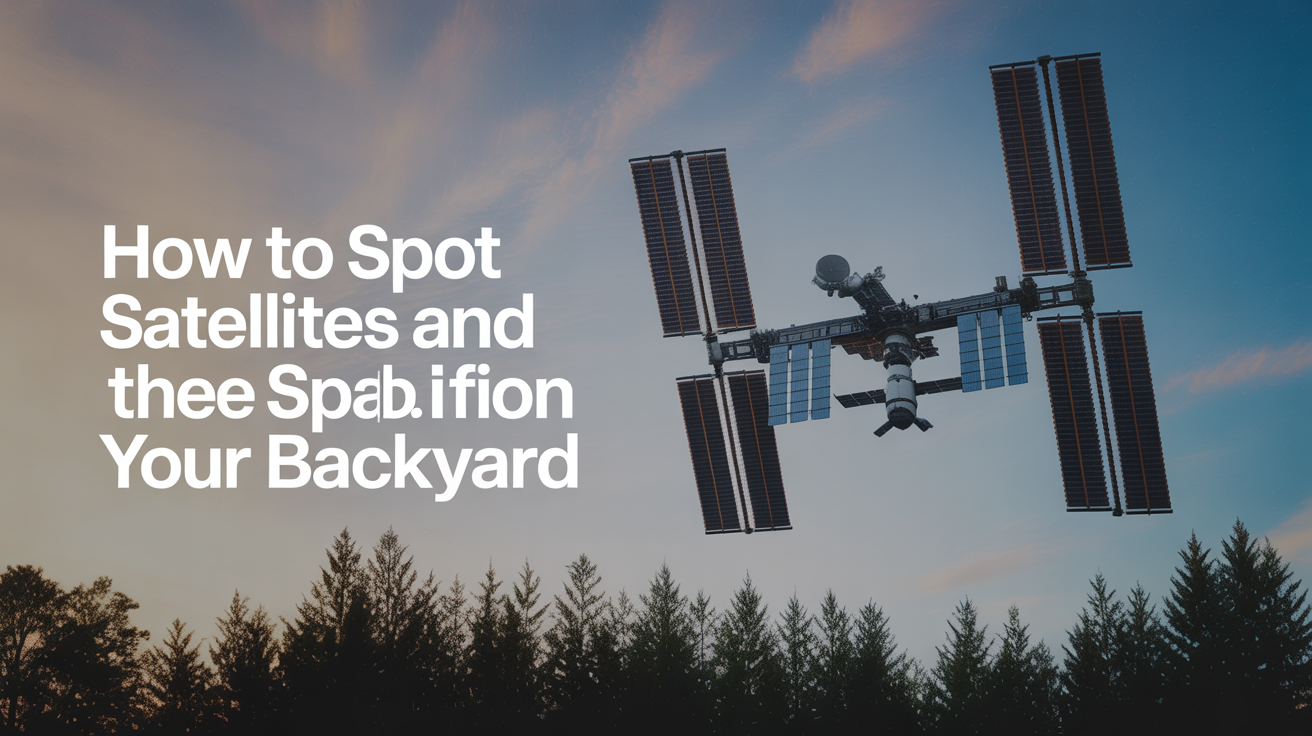
The ISS is visible to the naked eye from every continent, and on a good pass it outshines every star in the sky. You do not need a telescope or any special equipment to see it.
What the ISS Looks Like
The first time most people spot the International Space Station, they assume it is a plane. It moves across the sky at a steady pace, bright enough to cast a faint shadow on white paper, and it disappears without blinking out. That last detail is the key: it does not flash.
Aircraft carry red, green, and white navigation lights that pulse visibly. The ISS carries none of that. It glows with reflected sunlight and travels in a smooth, continuous arc. Once you know what to look for, it is unmistakable.
Brightness: On a favorable pass, the ISS reaches magnitude -3.5 or brighter, which puts it well above Venus and close to the maximum brightness achievable by a natural object in the night sky. On a lower-angle or shorter pass it may only reach magnitude 0 or 1, roughly equivalent to the brightest stars. Pass-prediction tools will tell you the peak magnitude before you go out.
Speed: It crosses the full sky in roughly three to five minutes, moving faster than any aircraft at altitude. It is not darting like a meteor; the motion is steady and purposeful, like a fast-moving star on a track.
Color: It usually appears white or slightly golden, depending on the angle of reflected sunlight.
The Best Time to See the ISS
The ISS orbits roughly 400 km above Earth. During the middle of the night, the station is in Earth's shadow and receives no sunlight, so it is invisible. The windows that work are the hour or so after sunset and the hour or so before sunrise. At those times, you are in the dark while the station is still high enough to catch direct sunlight.
This is the same reason bright planets and the Moon are easiest to photograph at twilight rather than in full darkness: the contrast between the sky and the object is gentler. For satellite spotting, the equation is simpler. You need a dark sky and a sunlit station at the same moment.
The geometry repeats in cycles. You may get several passes in a week, all in the morning window, then nothing visible for a few days, then a run of evening passes. The prediction tools handle all of this for you.
How to Use Pass-Prediction Tools
You do not need to memorize orbital mechanics. Three free tools cover the job:
Heavens-Above
Heavens-Above is the most detailed option. Set your location once, then pull up the ISS pass table for the next several days. Each row shows the date, start time, start azimuth, peak magnitude, peak altitude, and end time. The star-chart links let you see exactly where in the sky the pass will go, plotted over constellation lines.
For satellite spotting beyond the ISS, Heavens-Above also lists Iridium flares, Starlink strings, and hundreds of other tracked objects.
NASA Spot the Station
NASA runs a simple email and text alert service at spotthestation.nasa.gov. Enter your city, choose a minimum altitude (45 degrees filters out low, short passes), and the service sends an alert a few hours before each qualifying pass. No apps required, and it works anywhere with a cell signal.
Apps
Several mobile apps put pass predictions on a live sky view:
| App | Platform | Notable feature |
|---|---|---|
| ISS Detector | Android, iOS | Push alerts by elevation threshold |
| SkySafari | Android, iOS | Full star atlas with satellite layer |
| Stellarium Mobile | Android, iOS | Real-time sky overlay, ISS path visible |
| Heavens-Above (web) | Any browser | Most granular data, no install |
The apps with augmented-reality overlays let you hold your phone at the sky and see the projected path over real stars. This is useful for the first few times you go out, because you can compare the prediction to the actual object in real time.
What to read in the prediction: Look at peak altitude in degrees. Ninety degrees is straight overhead; 0 degrees is the horizon. A pass peaking above 40 degrees gives you a long, bright arc. A pass peaking at 15 degrees will be brief, dim, and easy to lose in haze or trees. For your first sighting, target a pass of at least magnitude 0 and peak altitude above 30 degrees.
Satellites vs. Planes: How to Tell Them Apart
At first glance, a satellite can look like a high-altitude aircraft. The differences are consistent once you know them.
Blinking lights: Planes always blink. The FAA requires it. A satellite never blinks unless it tumbles end over end, in which case the reflected light rises and falls in a slow, rhythmic cycle. Even a tumbling satellite has no colored navigation lights.
Speed: A satellite at low Earth orbit covers roughly 7.7 km per second. Against the star background, that translates to a crossing time measured in minutes. A plane at cruise altitude moves noticeably slower relative to the stars.
Altitude appearance: Planes tend to move horizontally across your field of view. Satellites follow arcs that can go in any compass direction, including nearly overhead-to-overhead passes.
The ISS specifically: The ISS is large enough to resolve as a tiny bar shape in binoculars or a small telescope if you track it carefully. Through 10x50 binoculars on a bright, high pass, the H-shaped structure of the solar arrays is faintly visible. This is not easy but it is possible on a steady hand.
Starlink Train Viewing
Since 2019, SpaceX has launched Starlink internet satellites in groups of dozens at a time. In the days immediately after a launch, before the satellites raise their individual orbits and spread out, they travel in a close chain called a train.
A fresh Starlink train looks like a string of pearls moving in slow single file, typically five to fifteen satellites visible at once depending on the launch batch and how much time has passed since deployment. The leading satellite is usually slightly brighter because its solar panel orientation differs. The train can stretch across 10 to 20 degrees of sky at peak clustering.
How to find Starlink passes:
- Heavens-Above lists individual satellites by their NORAD designations. After a launch, search for the newest Starlink batch.
- The website findstarlink.com (community-maintained) consolidates recent launch data and shows pass times specifically for clustered trains.
- Many astronomy forums and subreddits post sighting alerts after launches, often with pass times for major cities.
The train effect lasts only a few days. Within a week or two, the satellites have spread out across their orbital slots and are indistinguishable from any other steady point of light moving across the sky. Individual Starlinks are typically magnitude 4 to 6 at operational altitude, borderline naked-eye in a dark sky and invisible from a lit suburb.
SpaceX added sunshade visors to later batches of Starlink satellites to reduce brightness. The older batches without visors remain brighter. The ITU and astronomers continue to discuss long-term mitigation.
Other Satellites Worth Watching
The ISS and Starlink trains get the most attention, but thousands of other satellites are trackable. Some worth noting:
- HST (Hubble Space Telescope): Slightly fainter than the ISS at its best passes, but recognizable. Heavens-Above lists its passes.
- Tiangong (Chinese Space Station): Similar in brightness to the ISS on good passes, visible from most latitudes. Growing in size as new modules attach.
Satellite spotting pairs well with other naked-eye observing. While you are waiting for a pass, use the time to work through a meteor shower watch or check on whatever planets are up. The ISS occasionally transits the face of the Moon or a bright planet; transit prediction tools like transit-finder.com let you calculate whether your location will see the geometry.
Frequently Asked Questions
How bright does the ISS get?
At its best passes, the ISS reaches around magnitude -3 to -4, brighter than any star and comparable to Venus at its peak. Lower-angle passes may only reach magnitude 0 to 1. The prediction tools will show the expected magnitude for each specific pass.
Why can I sometimes not see the ISS even when a pass is predicted?
The most common reasons are atmospheric haze at the horizon, the station passing through Earth's shadow partway through the orbit, or the pass being too low in the sky (below 20 degrees) to clear trees or buildings. Try a pass with a peak altitude above 35 degrees and check the weather forecast for thin cloud cover.
Can I photograph the ISS?
Yes. The most accessible method is a DSLR or mirrorless camera on a tripod, set to a 20 to 30 second exposure at ISO 800 to 1600 with a wide-angle lens. The ISS leaves a dotted or continuous streak across the frame depending on shutter speed. Getting a sharp image of the actual structure requires a telescope on a motorized mount and precise tracking.
What is a Starlink train and how long does it last?
A Starlink train is a group of newly launched satellites traveling close together before raising to their final orbits. The tight clustering is visible for roughly three to seven days after launch. After that, the satellites spread out and are no longer distinguishable as a group.
How does the Moon's phase affect satellite watching?
A full Moon brightens the sky background, which makes faint magnitude-4 or -5 satellites harder to see. The ISS is bright enough to stand out regardless of Moon phase, but dim Starlink satellites at operational altitude become difficult under a bright Moon. Planning your watch around a meteor shower or a satellite pass during the new Moon phase gives you the best contrast. You can also combine a satellite watch with checking on the visible planets during the same session.