Getting Started
Learning the Constellations: A Beginner's Starting Path
A practical guide to learning the constellations step by step, starting with anchor patterns like the Big Dipper, Orion, and Cassiopeia.
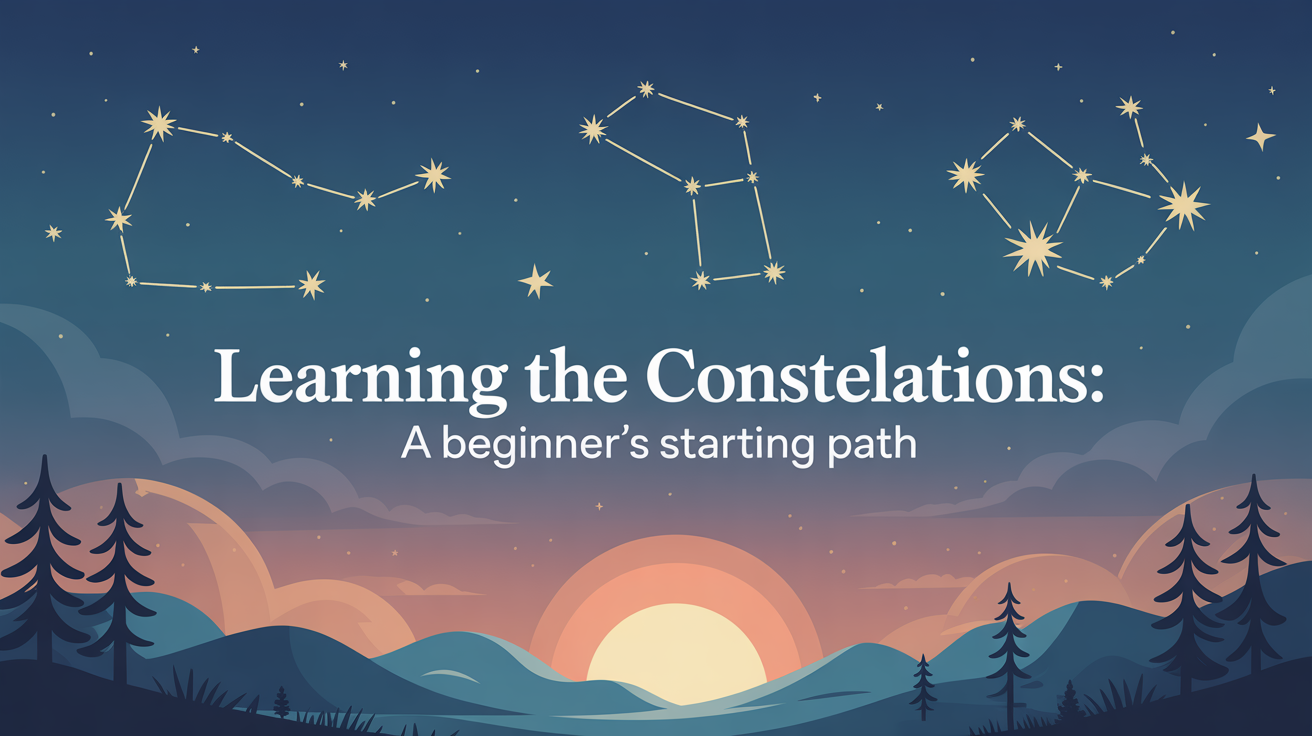
The fastest way to learn the constellations is to start with three or four anchor patterns you can find on almost any clear night, then build outward from there one season at a time.
Why Most Beginners Get Stuck
When you step outside on a clear night, the sky can look overwhelming. There are thousands of stars visible to the naked eye, and traditional star charts show all of them at once. That is the wrong place to start.
The problem is not the constellations themselves. Most of the 88 official constellations are faint, irregular, or look nothing like what they are named after. The ones worth learning first are the ones with a strong geometric shape you can pick out immediately, even from a moderately light-polluted backyard.
If you try to learn all 88 at once, you will remember none of them. If you pick three or four bright, distinctive patterns and spend a few weeks finding them repeatedly until they feel automatic, you build a mental map that the rest of the sky attaches itself to naturally.
Start With Four Anchor Patterns
These four are the right place to begin. They are visible from most of the Northern Hemisphere, have strong shapes, and appear at different times of year, so between them they cover most of the sky.
The Big Dipper (part of Ursa Major)
The Big Dipper is technically an asterism, a recognizable shape within the larger constellation Ursa Major, not a standalone constellation. But it is the most useful starting point in the sky because it is circumpolar from most of North America and Europe, meaning it never fully sets. You can find it any clear night, all year round.
The Dipper's bowl and handle are made from seven bright stars arranged in an unmistakable shape. Once you have found it, the two stars forming the outer edge of the bowl (called the pointer stars) point directly toward Polaris, the North Star. That single trick gives you north from anywhere in the Northern Hemisphere without a compass.
Orion
Orion is the best constellation in the winter sky and arguably the most recognizable pattern anywhere in the sky. The three stars of Orion's Belt sit in a near-perfect line, and surrounding them are four bright stars marking the hunter's shoulders and feet. Rigel (lower right, blue-white) and Betelgeuse (upper left, noticeably orange-red) are two of the brightest stars visible at night.
Find Orion once and you unlock a dozen nearby objects: the Orion Nebula hangs below the belt as a faint smudge visible to the naked eye, and a line extended through the belt stars points straight toward Sirius, the brightest star in the entire night sky.
Cassiopeia
Cassiopeia is another circumpolar constellation, sitting on the opposite side of Polaris from the Big Dipper. Its five main stars form a clear W shape (or M, depending on where it sits in its rotation). On any night when the Big Dipper is low on the horizon or blocked by trees, Cassiopeia will likely be high overhead instead. The two patterns take turns being well-placed, which makes them a natural pair to learn together.
The Summer Triangle
The Summer Triangle is an asterism made from three bright stars in three separate constellations: Vega in Lyra, Deneb in Cygnus, and Altair in Aquila. It dominates the overhead sky from summer through early autumn. Learning it teaches you three constellations at once, and Cygnus has a cross shape (the Northern Cross) that is easy to trace once you know where to look.
The Star-Hopping Method
Star-hopping is the technique of using known stars as stepping stones to find new ones. It is how both beginners and experienced observers navigate the sky, and it works just as well with your eyes as with binoculars or a telescope eyepiece.
A few reliable hops to practice early on:
- From the Big Dipper's pointer stars, follow the line about five times the distance between them and you hit Polaris.
- From the Big Dipper's handle arc, "follow the arc to Arcturus" (a bright orange star) and then "speed on to Spica" (a blue-white star lower in the sky). Two new bright stars from one memory hook.
- From Orion's Belt, extend the line of three stars toward the lower left and you reach Sirius, the brightest star in the night sky.
How to read a star chart and find your way around the sky covers the mechanics of combining star-hopping with an actual chart if you want to go further with this technique.
Learn a Few Per Season, Not All at Once
The sky rotates through roughly four seasonal faces over the course of a year. Each season brings a new set of prominent constellations into the evening sky. This rotation is your natural study schedule: you do not need to learn winter constellations during summer because they are barely visible then anyway.
Here is a practical starting set by season, sized for a beginner:
| Season | Anchor Pattern | 2-3 Add-Ons to Try |
|---|---|---|
| Spring | Big Dipper (high overhead) | Leo, Bootes (find Arcturus via the arc hop) |
| Summer | Summer Triangle | Scorpius, Sagittarius (toward the galactic center) |
| Autumn | Cassiopeia | Pegasus (the Great Square), Andromeda |
| Winter | Orion | Taurus, Gemini, Canis Major (Sirius) |
The table is kept short on purpose. Two or three constellations per season is a realistic target for how to identify constellations reliably. Learn them well enough to find each one in under a minute, in the dark, without looking at a chart. Then add one more.
After a full year of this approach, you will know 12 to 16 constellations comfortably, plus the major navigational stars that connect them. That is enough to find your way around most of the sky on any given night.
Using the Sky's Daily and Seasonal Rotation
Two kinds of movement shape what you see:
Daily rotation: The whole sky appears to rotate from east to west over 24 hours (because Earth spins west to east). A constellation that rises in the east at 9 pm will be higher in the south by midnight and setting in the west by 3 am. The best time to observe any constellation is when it is highest in the sky, roughly due south for mid-northern latitudes, where it clears the most atmosphere.
Seasonal shift: Because Earth also orbits the Sun, the sky shifts westward by about two hours per month. Orion is a winter constellation in the evening sky not because stars disappear but because Earth's orbital position means the Sun sits in the same part of the sky as Orion during summer, washing it out in daylight. Come winter, the Sun has moved away and Orion rises with the darkness again.
Once you understand this, you can predict roughly where a constellation will be on any given night. Scorpius rises in the southeast in early summer evenings. By late summer it sits in the south. By autumn it slips below the horizon shortly after sunset. Each constellation has a peak season when it is well-placed for comfortable viewing.
What you can actually see in the night sky with your eyes alone covers what is worth looking for once you know where to point your gaze. The Moon, planets, clusters, and a handful of naked-eye deep-sky objects are all findable with no equipment beyond your own eyes.
Tools That Help (and When to Put Them Away)
A red flashlight and a basic planisphere (a rotating paper star wheel matched to your latitude) are enough to learn the constellations. Both work without batteries or internet.
Apps like Stellarium, Sky Map, or SkySafari are useful for previewing the sky before you go out. They are less useful as a crutch while you are outside -- holding a bright screen up ruins your night vision and prevents you from building a mental map. Use the app to plan what you want to find, then put it away and locate things from memory.
If you are ready to go beyond naked-eye observing, how to start stargazing as a complete beginner covers what equipment is worth owning and what to skip at the start.
Frequently Asked Questions
How long does it take to learn the constellations? Most people can reliably find 10 to 15 prominent constellations after about six months of casual observing, meaning roughly one session per week outdoors. The pace depends almost entirely on how often you go outside and practice finding things, not on how much you read about them.
Do I need a telescope to learn the constellations? No. Constellations are naked-eye objects. A telescope actually makes them harder to learn because it narrows your field of view so much that you cannot see the full pattern at once. Learn the sky with your eyes first. A telescope becomes useful later, for looking at specific objects within constellations you have already located.
What are the easiest constellations to find for beginners? The Big Dipper, Orion, Cassiopeia, and the Summer Triangle are the four that most beginners pick up first. All have distinctive shapes made from bright stars, and all are visible from most populated parts of the Northern Hemisphere for at least part of the year.
Why do the constellations look different from what I expected? Most constellations do not look much like their names suggest. Orion is one of the few that actually resembles a human outline. The rest are more abstract, named from mythology rather than appearance. It helps to learn them as geometric patterns first (a W shape, a dipper, a cross) rather than trying to trace a figure in them.
Should I learn the star names too? Not at first. The constellation shapes are enough to start navigating. Once you know where a constellation sits in the sky, you can pick up the names of its brightest stars gradually over time. Focus on Sirius, Vega, Arcturus, and the stars of Orion's Belt early on -- those names come up constantly in star-hopping instructions and observing guides.