Telescopes & Gear
Should a Beginner Choose a GoTo Telescope or a Manual One
GoTo telescope vs manual: compare cost, learning curve, battery needs, and cold-weather reliability to find the right first scope for you.
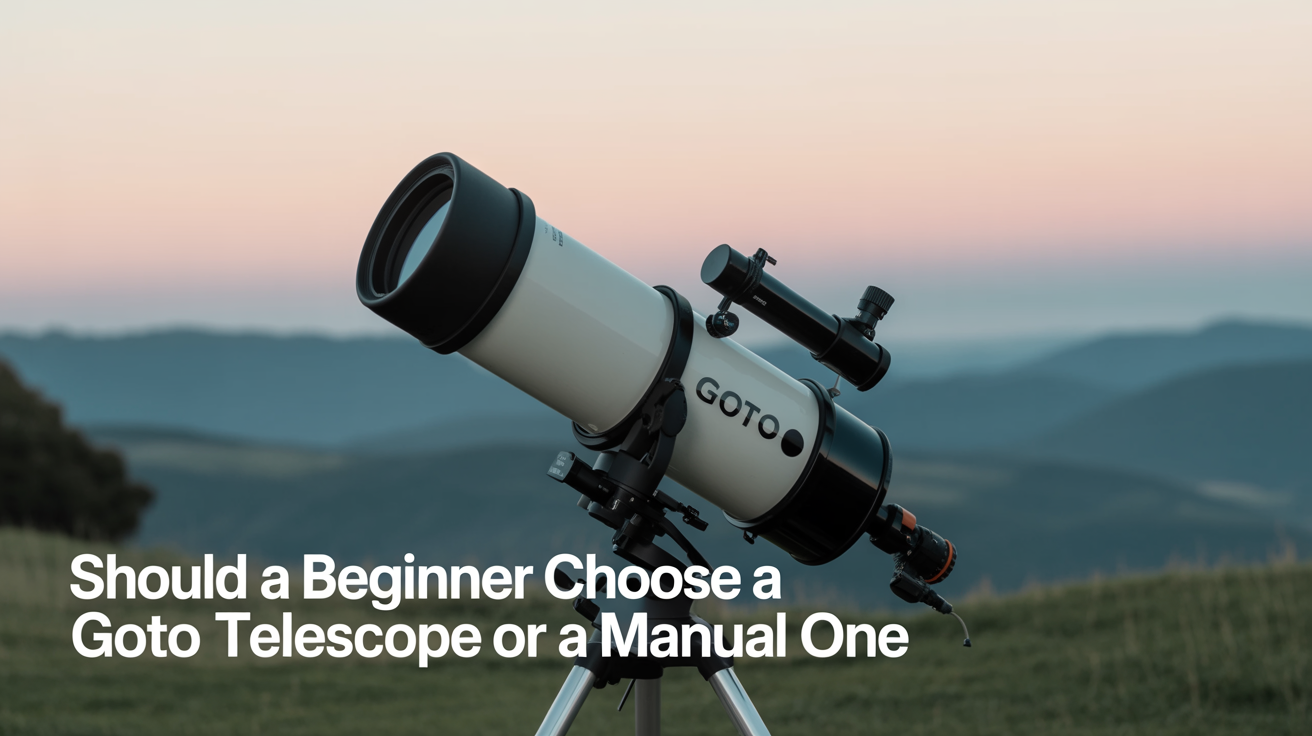
Every beginner hits this fork in the road eventually. You've narrowed your search down to actual telescopes, and now you're staring at two very different kinds of listings: one with a hand controller and a database of thousands of objects, the other with nothing but a tube on a simple mount that you point yourself. The goto telescope vs manual decision isn't really about which one is "better." It's about which kind of beginner you are, and being honest with yourself about that will save you money and frustration.
I've owned both. I started manual because that's what I could afford, then added a GoTo scope years later when I got tired of hunting for faint galaxies on nights with only ninety minutes to spare. Both were the right call at the time.
What GoTo and Manual Actually Mean
A manual telescope, most commonly a Dobsonian, has no motors and no electronics. You find objects with a finder scope and your own knowledge of the sky, then nudge the tube by hand to keep them centered as the Earth rotates them out of view. A push-to telescope sits in between: still no motors, but a small computer tracks where the tube is pointed and tells you which way to nudge it toward a target you've selected. A GoTo telescope has motors that slew the scope automatically once it's aligned on a couple of reference stars, then drive to almost anything in its database and keep tracking it.
Underneath all the marketing, goto telescope vs manual comes down to how much of the "finding" you want a machine to do for you.
Upfront Cost: Where the Money Actually Goes
Dollar for dollar, a manual Dobsonian gives you more aperture, meaning more light-gathering power and sharper, brighter views, than a GoTo scope at the same price, because you're not paying for motors, a hand controller, or a computerized mount. An 8-inch Dobsonian and an entry-level 5 or 6-inch GoTo scope often land in a similar price range, but the Dobsonian shows dimmer galaxies and nebulae in more detail simply because it's swallowing more light.
GoTo scopes also tend to hide costs beyond the sticker price: a separate battery pack, or a wobbly stock tripod that frustrates you into buying a sturdier one. Budget an extra buffer if you're going the GoTo route, and lean toward the Dobsonian if your budget is genuinely tight.
The Learning Curve: Star-Hopping vs Alignment Routines
This is where the two paths diverge the most, and it's worth understanding both before you buy.
With a manual scope, you learn to star-hop: starting from a bright, easy-to-identify star and moving in small, deliberate steps through the finder scope until you land on your target. It's slow at first, and your first few sessions might be spent finding just the Orion Nebula and nothing else. But every object you find this way teaches you the shape of a constellation and how your finder scope's field of view maps onto the real sky. After a season or two, most people can point a telescope by memory to a dozen or more objects without a chart.
A GoTo scope replaces that entire process with an alignment routine. You center two or three bright stars in the eyepiece one at a time, the mount does some internal math, and after that you select an object from a menu and the scope drives there on its own. The routine itself takes a few minutes once you're used to it, though your first attempts will take longer while you learn the menu and identify alignment stars. Once aligned, the learning curve mostly disappears; you still need to know roughly where things are in the sky to plan a session, but you're not required to.
Neither approach is wrong. A GoTo mount gets you looking at more objects sooner, especially faint ones that would take a beginner many frustrating minutes of star-hopping to track down. A manual scope makes you a better observer in the process of using it, and that skill sticks with you even if you upgrade equipment later.
Power, Batteries, and Cold-Weather Reliability
A manual Dobsonian needs zero power. You can use it during a grid outage, on a camping trip, or for years without ever thinking about batteries, and that simplicity matters for a beginner who just wants to grab the scope and go outside. Cold weather affects it only through stiffer bearings, usually fixed with cold-rated grease or by letting the mount acclimate outdoors before you start.
A GoTo mount needs a power source, usually a rechargeable pack or AA batteries in a cheaper controller, and it will die at the worst possible moment if you forget to charge it. Cold makes this worse, since batteries lose capacity as temperatures drop, and hand-controller screens can get sluggish in a hard freeze. None of this is a dealbreaker, but if you go GoTo, buy a dedicated outdoor-rated power pack, keep it charged, and keep a backup warm in an inside pocket on cold nights.
How Each Choice Shapes Your Skill-Building
This is the part that doesn't show up on a spec sheet but matters more than most buyers expect. A GoTo mount can shortcut the process of learning the sky by hand. If your goal is purely to see as many objects as possible with the least friction, that's a feature, not a flaw, and plenty of experienced amateurs run GoTo mounts every night while still knowing the sky cold. Owning one doesn't prevent you from learning constellations, it just doesn't force you to.
But if you're a true beginner, there's real value in the forced patience of a manual scope. Star-hopping builds spatial memory of the sky in a way that clicking through a menu doesn't. Many longtime observers trace their favorite skill, walking outside and pointing a telescope at Saturn with no chart, back to years of manual searching. You can learn that later even if you buy GoTo first, but most people don't, simply because the mount removes the need.
Push-To Mounts: The Middle Ground Worth Knowing About
If you like the idea of a nudge in the right direction without full automation, look at push-to telescopes. These use the same kind of digital setting circles as a GoTo mount, so a small display tells you which direction and how far to move the tube, but you're still doing the physical work of finding the object yourself. It's a genuine middle path, faster than pure star-hopping on faint or oddly placed targets while keeping you engaged with where things are in the sky. Push-to scopes also cost less than full GoTo models and need less power, since nothing is slewing on its own.
If star-hopping appeals to you in theory but you're worried about giving up after a few frustrating nights, a push-to Dobsonian is worth serious consideration before you commit to either extreme.
Which Should You Buy? A Clear Recommendation
Choose manual, most likely a Dobsonian, if you're on a tight budget, want the biggest aperture for your money, and don't mind a slower start while you learn the sky as a skill. This is the classic beginner's path, recommended in most beginner buying guides for good reason: it rewards patience with real competence.
Choose GoTo if you have less patience for searching, want to see a wide variety of objects in one session without hunting for each, and don't mind managing a battery and an alignment routine. This suits observers with limited time, people observing with kids who lose interest quickly, or anyone who's tried manual and found the searching more tedious than rewarding.
Choose push-to if you can't decide, or want the engagement of manual searching with less frustration on faint or hard-to-locate targets.
Whichever mount you choose, the optical design underneath it (refractor, reflector, or the specific case of a Dobsonian) matters just as much for what you'll see through the eyepiece. Read up on telescope types before you settle on a model, since the same mount can carry very different optics with very different strengths.
Frequently Asked Questions
Is a GoTo telescope worth it for a complete beginner?
It can be, especially if your main obstacle to stargazing is limited time or patience. The tradeoff is that you'll rely on the mount to find things rather than learning to find them yourself, at least at first. If budget is tight, a manual scope of larger aperture will usually show you more for the same money.
Do GoTo telescopes need internet or wifi to work?
No. The object database lives on the hand controller itself. Some mounts offer optional wifi or Bluetooth to control the scope from a phone app, but core alignment and slewing works with no internet connection, which matters if you're observing somewhere remote.
How long does GoTo mount alignment take?
Once you know your mount, a typical two or three-star alignment takes five to ten minutes. Your first few attempts will likely take longer while you get comfortable identifying alignment stars and navigating the menu.
Can a manual telescope track objects like a GoTo one does?
A basic Dobsonian cannot track automatically; you nudge it by hand every minute or two as the sky appears to drift. Some manual mounts add optional motorized tracking without full GoTo slewing, which is a nice middle step if you find manual tracking tedious but don't want a full computerized mount.
Will owning a GoTo telescope stop me from learning the constellations?
Not automatically, but it removes the requirement. Learning the sky with a GoTo scope takes deliberate effort, like studying star charts on your own time or occasionally aligning by eye instead of relying on the menu. Plenty of GoTo owners know the sky well; it just takes more intention than it does with a manual scope, where star-hopping builds that knowledge as a side effect of ordinary use.