Telescopes & Gear
Telescope Mounts: Alt-Az vs. Equatorial for Beginners
Learn the difference between alt-az and equatorial telescope mounts, how GoTo systems work, and which mount type suits beginners for visual observing or astr...
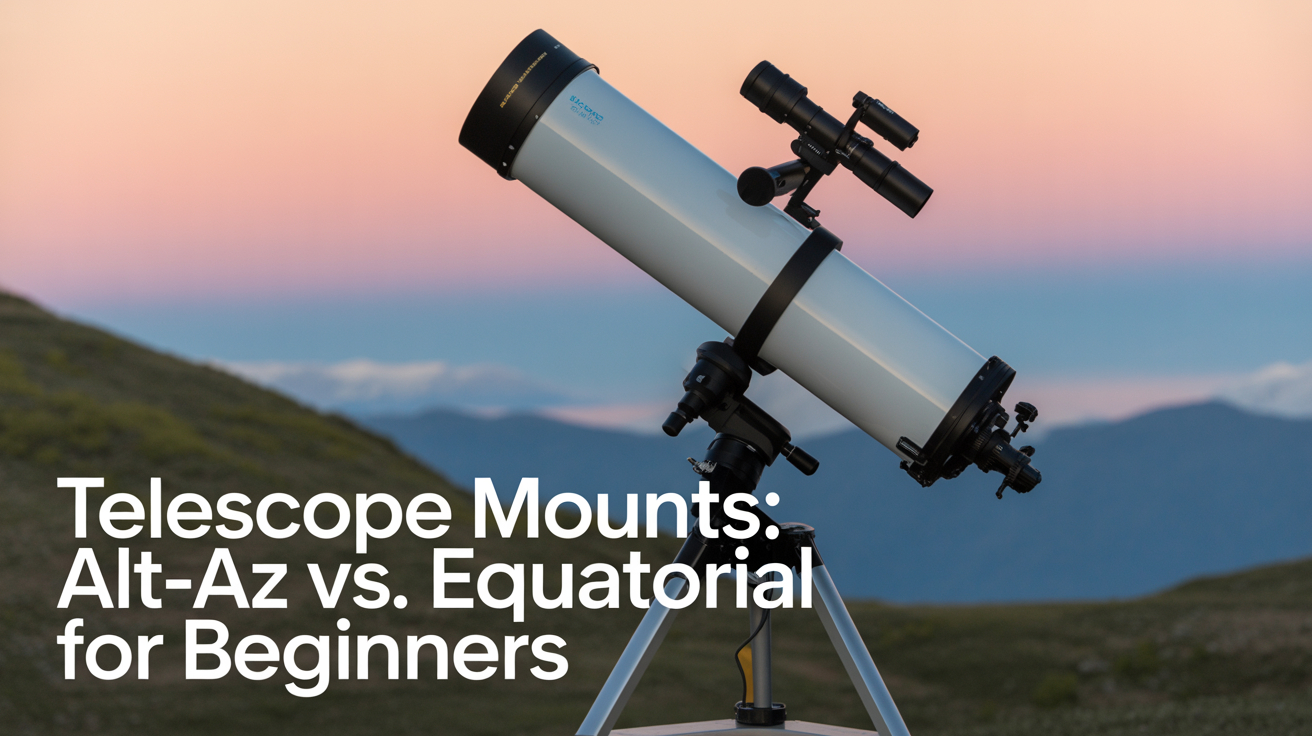
The mount under your telescope matters as much as the optics above it. Get the mount wrong and even a quality tube becomes frustrating to use; get it right and the sky opens up much faster.
What a Mount Actually Does
The Earth rotates, so every object in the sky appears to drift westward over time. At high magnification that drift is fast enough to push an object out of view within a minute or two. A telescope mount holds the tube at the right angle and lets you move it smoothly, and on motorized mounts, it compensates for that rotation automatically so objects stay centered.
There are two fundamentally different ways to design that movement. One mirrors how we naturally point at things. The other mirrors how the sky itself moves.
Alt-Az Mounts: Up-Down and Left-Right
An alt-az mount moves in two directions: altitude (up and down) and azimuth (left and right). That is the same way you naturally point your finger at something in the sky, so the learning curve is close to zero.
Manual alt-az mounts
The simplest version is a pan-and-tilt head or a basic two-axis rocker. You grab the telescope, push it to where you want it, and let go. These are lightweight, cheap, and get beginners looking at the sky in minutes. The downside is that tracking a target by hand at 150x or higher requires small, constant nudges. Most people find it works fine for the Moon and planets, which are bright and forgiving, but tiring for faint deep-sky objects where you need to hold still and let your eye adapt.
Dobsonian mounts
The Dobsonian is a specific type of alt-az design built around a large-diameter Newtonian reflector. A wide, low-profile rocker box sits on a ground board, and the tube pivots on two altitude bearings. Because the base is so stable and the bearings have just the right amount of friction, you can push a big, heavy tube with one finger and stop it exactly where you want. Dobsonians are the reason many beginners end up with a 200mm or 250mm aperture for the price of a small refractor on an inferior mount. If visual observing of planets and deep-sky objects is your main goal, a manual Dobsonian punches well above its price. Read more about the tradeoffs in Refractor, Reflector, or Dobsonian: Telescope Types Explained.
Alt-az with motors
Motorized alt-az mounts add two motors, one for each axis, and track targets by constantly adjusting both. This works well for visual use and for planetary video imaging where exposures are very short. For deep-sky astrophotography with long exposures it falls short, because driving two axes at variable speeds introduces a rotation artifact called field rotation, where the frame slowly spins around the center of the image. That shows up as trailed stars at the edges of a long exposure.
Equatorial Mounts: One Axis Follows the Sky
An equatorial mount is tilted so that one of its axes, called the right ascension (RA) axis or polar axis, points at the celestial pole. Because it points at the same spot the sky appears to rotate around, a single motor driving just that one axis can track any object perfectly with no field rotation. That makes equatorials the standard choice for astrophotography.
German equatorial mounts
The German equatorial mount (GEM) is the most common type for amateur telescopes. A counterweight shaft hangs off one side of the RA axis and the telescope tube sits on the other, balanced so the whole assembly turns smoothly. Most beginner equatorial mounts sold today are GEMs.
The penalty you pay is setup complexity. The mount looks awkward if you have never used one, the counterweight can swing into the tripod at certain positions, and you occasionally have to do a "meridian flip" when a target crosses from east to west of the meridian. None of these are hard to manage, but they take a session or two to feel comfortable.
Polar alignment
For a GEM to track accurately, the polar axis must point as close as possible to the celestial pole. In the northern hemisphere that means pointing it at Polaris (which sits less than a degree from the true pole). Most mounts include a polar alignment scope or a reticle illuminated with hour angle markings. A rough polar alignment takes two or three minutes and is accurate enough for visual use or short astrophotography exposures. Precise alignment for long-exposure imaging takes longer and usually involves software routines such as drift alignment or three-star polar alignment.
If you skip polar alignment entirely, the mount will still work for visual observing, but the tracking will drift off target steadily instead of keeping the star centered.
GoTo and Push-To: Computer-Assisted Finding
Both mount types can be paired with computer assistance, and this is where beginners often have questions.
What is a GoTo mount?
A GoTo mount has two motorized axes and an onboard computer or a connected handset. After a short alignment procedure, where you point the telescope at two or three known stars, the computer knows where the scope is aimed relative to the whole sky. You then scroll through a catalog, select an object, press a button, and the motors drive the telescope directly to it. GoTo mounts are available in both alt-az and equatorial versions.
For beginners who want to find a lot of different objects quickly, a GoTo mount removes a significant barrier. The downside is that the alignment takes a few minutes, the handsets can be fiddly, and if you power the system off and move the tripod you need to realign from scratch. GoTo systems also add cost and weight.
One thing GoTo does not do is teach you the sky. If you rely on it every session, you may never learn to star-hop or find your way around without the computer. Many observers find that mixing both approaches, using GoTo for hunting faint objects and star-hopping for familiar ones, works well in practice.
What is a push-to (or digital setting circles) system?
Push-to is a halfway point between GoTo and a manual mount. Two encoders on the axes track the physical angle of the mount in real time. An app on a phone or a small display tells you which direction to push the tube manually to reach a target. There are no motors; you do the moving yourself. This is common on large Dobsonians where adding powerful motors to drive a heavy tube would be expensive and often unnecessary.
Which Mount Type Should a Beginner Choose?
The answer depends mostly on what you want to do at the eyepiece.
| Goal | Recommended mount type |
|---|---|
| Visual observing, moon and planets | Manual alt-az or Dobsonian |
| Visual observing, lots of deep-sky objects | GoTo alt-az or GoTo equatorial |
| Planetary video imaging (short clips) | GoTo alt-az or motorized alt-az |
| Deep-sky astrophotography | GoTo equatorial (GEM) |
| Learning the sky star-hop style | Manual Dobsonian |
For most people starting out with visual observing, a manual Dobsonian or a basic GoTo alt-az is the right call. Equatorial mounts earn their complexity only when you need accurate tracking and no field rotation for longer photographic exposures.
If you are still deciding on the telescope itself, the mount and tube are usually bundled together, so read How to Choose Your First Telescope: A Beginner's Buying Guide before committing. Also keep in mind that aperture and focal length shape what you can see before the mount even enters the picture; Aperture vs. Magnification: What Actually Matters in a Telescope explains that side of things clearly.
A note on budget
An equatorial mount that tracks accurately enough for astrophotography costs noticeably more than a decent visual setup. Cheaper equatorial mounts, often sold with a small refractor as a "astronomy starter kit," frequently wobble, track poorly, and put beginners off the hobby. If the budget does not stretch to a solid GEM, a Dobsonian for visual use is a much better experience than a shaky EQ.
Frequently Asked Questions
Can I use an alt-az mount for astrophotography? For planetary and lunar imaging with video capture, yes. For deep-sky imaging with exposures longer than about 30 seconds, the field rotation that alt-az tracking produces will blur the stars at the edges of the frame. A properly polar-aligned equatorial mount is the standard solution for long-exposure deep-sky work.
Do I need GoTo as a beginner? No, but it helps with finding objects. Manual mounts force you to learn the sky, which many observers consider worthwhile. GoTo mounts speed up target acquisition and are useful if you only have short windows of clear sky. Either approach can work; it is really a matter of how you prefer to spend your observing time.
What does polar alignment involve exactly? You tilt the RA axis until it points at the celestial pole, using the latitude scale on the mount and a compass bearing for azimuth. Then you refine it by centering Polaris in the polar scope or using a drift alignment routine. A rough three-minute polar alignment is enough for visual observing or short planetary exposures; pinpoint alignment for hour-long deep-sky exposures takes longer but follows the same principle.
What is a single-arm alt-az mount? Many compact GoTo telescopes use a single-arm fork that holds the tube on one side only. These are lighter and more portable than a full GEM but generally less rigid under heavy optical tubes. They work well for visual observing and short exposures on a small telescope.
Can I add a motor to my existing manual mount? For alt-az mounts it depends on the design; some manufacturers sell motor drive kits for their Dobsonians. For manual German equatorial mounts, a single-axis RA motor drive is a common and inexpensive upgrade that provides basic tracking. Two-axis motorized upgrades exist as well, though a proper GoTo conversion typically requires a new head rather than a bolt-on kit.