Sky This Month
What Are Conjunctions and Oppositions? A Planet-Watcher's Guide
Planetary conjunction explained: what conjunctions, oppositions, and elongations mean, when to look for them, and what you can realistically see.
A planetary conjunction is when two or more solar system objects appear close together in the sky as seen from Earth. An opposition is when an outer planet sits directly opposite the Sun from our viewpoint, putting it at its closest and brightest for the year. Both events give backyard observers a specific reason to go outside on a particular night.
At a Glance
- A conjunction is a line-of-sight effect: two objects look close together from Earth, even if they are hundreds of millions of kilometers apart in real space.
- Opposition only applies to outer planets (Mars, Jupiter, Saturn, Uranus, Neptune) and marks the night each is closest, brightest, and visible all night long.
- Mercury and Venus, the inner planets, can never reach opposition; instead they swing to a maximum angle from the Sun called greatest elongation.
- Mars is the planet most transformed by opposition, appearing up to about three times larger through a telescope than at its faintest, but favorable oppositions only happen every 15 to 17 years.
- "Planets lining up" headlines describe an ordinary, recurring alignment along the ecliptic, not a rare three-dimensional coincidence.
- Free tools like the Royal Observatory Greenwich's guides or apps such as Stellarium and SkySafari list exact dates for your location.
What Is a Conjunction?
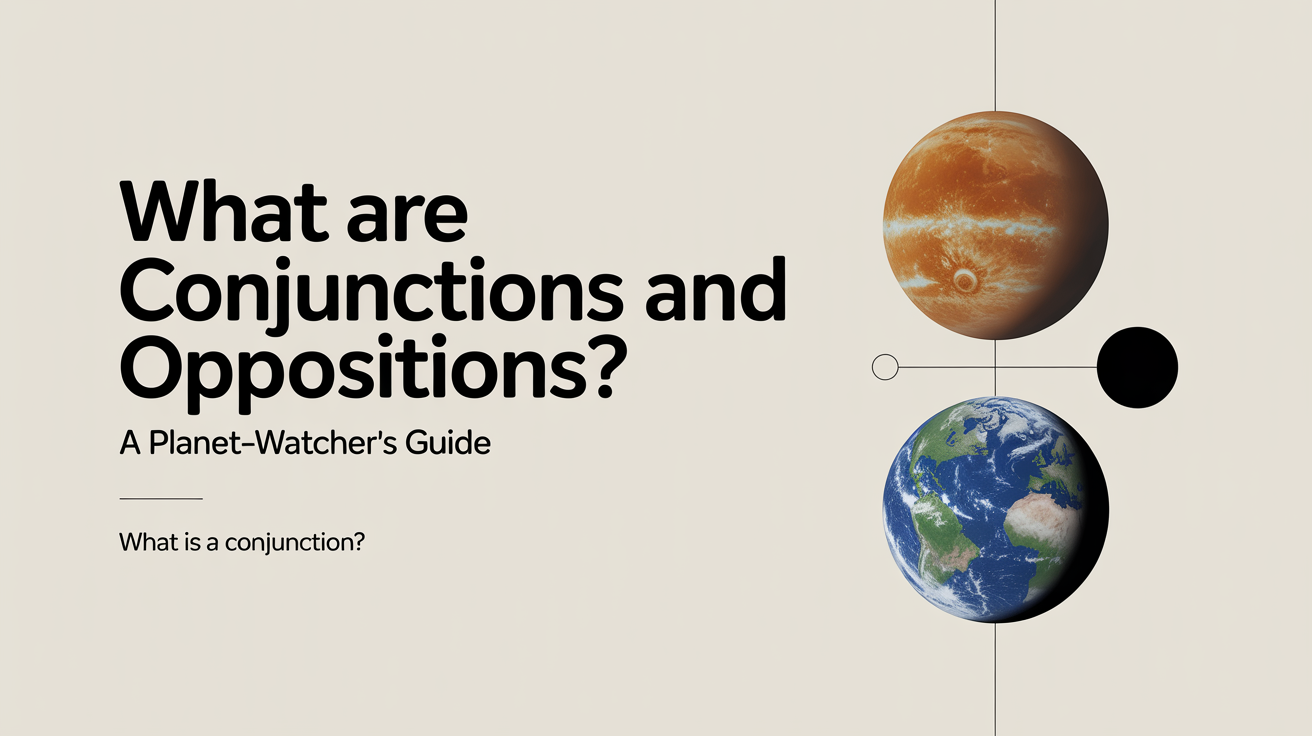
The word "conjunction" just means apparent closeness. When two planets, or a planet and the Moon, drift near enough in the sky to look like a pair, astronomers call that a conjunction. As the Royal Observatory Greenwich explains, a conjunction happens whenever two astronomical objects, such as asteroids, moons, planets, or stars, appear to sit close together from Earth's point of view, even though they may be separated by enormous real distances.
"Near" is relative. A conjunction might put two planets half a degree apart (close enough to share the same low-power binocular field) or several degrees apart (still called a conjunction, but not a dramatic sight). The threshold used in most almanacs is a separation of less than a few degrees, though no single cutoff is universal.
What matters practically:
- Close conjunctions (under 1 degree) fit both objects in the same eyepiece view. These are worth a photograph.
- Wide conjunctions (1 to 5 degrees) are best seen with the naked eye or binoculars and are mainly interesting as a visual landmark.
- Planetary conjunctions with the Moon happen every month because the Moon moves through the whole zodiac in about 27 days. A crescent Moon near Venus or Jupiter is one of the most accessible sights in amateur astronomy.
A conjunction does not mean the objects are physically close. Venus and Jupiter might appear to almost touch in the sky while being hundreds of millions of kilometers apart in three-dimensional space. The pairing is purely a line-of-sight effect.
Superior and Inferior Conjunction
For Mercury and Venus (the inner planets), astronomers distinguish between two types:
- Superior conjunction: the planet passes behind the Sun from our viewpoint. It is lost in the Sun's glare and unobservable.
- Inferior conjunction: the planet passes between Earth and the Sun. It is also generally lost in the glare, though a very thin crescent can sometimes be glimpsed low on the horizon just before or after this point.
These terms do not apply to outer planets (Mars, Jupiter, Saturn, and beyond), which can never pass between Earth and the Sun.
What Is an Opposition?
Opposition is the position that makes outer planets easiest to observe. When Earth lies directly between the Sun and an outer planet, that planet is at opposition. The Royal Observatory Greenwich defines it plainly: only planets that orbit farther from the Sun than Earth does, Mars, Jupiter, Saturn, Uranus, and Neptune, can be in opposition, because Venus and Mercury never get to the far side of Earth from the Sun.
A planet at opposition:
- Rises near sunset and sets near sunrise
- Is visible for most of the night
- Is at or near its closest point to Earth for that orbit cycle
- Appears larger and brighter than at any other time of year
These effects are most noticeable for Mars, which has a noticeably elliptical orbit. At a favorable opposition, Mars appears roughly three times larger in diameter through a telescope than at its faintest. At an unfavorable opposition it is still the best Mars will look that year, but the disk is smaller.
For Jupiter and Saturn, the change between opposition and other orbital positions is less dramatic because both planets are much farther from the Sun, so the distance variation is smaller proportionally.
What You Can See at Opposition
| Planet | Approximate opposition frequency | Notable features at opposition |
|---|---|---|
| Mars | Every 26 months | Orange disk; polar caps visible in telescope |
| Jupiter | Every 13 months | Cloud belts; all four Galilean moons visible in binoculars |
| Saturn | Every 12.5 months | Rings at maximum visual width; Titan visible in small scope |
| Uranus | Every 12 months | Tiny blue-green disk; technically naked-eye but faint |
| Neptune | Every 12 months | Requires binoculars minimum; blue-gray disk only in telescope |
Binoculars reveal Jupiter's moons and Saturn as slightly non-circular at opposition. A 60mm or larger telescope shows cloud detail on Jupiter and the ring system on Saturn.
Elongation: How Inner Planets Work
Mercury and Venus never appear opposite the Sun from Earth's perspective because they orbit closer to the Sun than we do. Instead, they swing from one side of the Sun to the other. The maximum angle they reach from the Sun is called greatest elongation.
- Greatest eastern elongation: the planet is east of the Sun, visible in the evening sky after sunset.
- Greatest western elongation: the planet is west of the Sun, visible in the morning sky before sunrise.
Mercury reaches greatest elongation roughly every three months, but the angle varies between about 18 and 28 degrees. Because Mercury stays so close to the Sun, it is only visible for a short window near the horizon, usually within an hour of sunset or before sunrise.
Venus reaches greatest elongation at about 47 degrees from the Sun, giving it a longer viewing window. At greatest elongation, Venus shows a half-phase through even a small telescope, similar to a quarter Moon. A 70mm refractor shows the crescent clearly.
Elongation and Opposition, Side by Side
| Term | Applies to | What it marks | Typical viewing window |
|---|---|---|---|
| Greatest elongation | Mercury, Venus | Maximum angular distance from the Sun | Within about an hour of sunrise or sunset |
| Opposition | Mars, Jupiter, Saturn, Uranus, Neptune | Closest approach; opposite the Sun in the sky | All night, sunset to sunrise |
| Conjunction (any planet) | All planets and the Moon | Apparent close approach to another object | Whenever the pairing occurs, often just after sunset |
| Solar conjunction | All planets | Lost in the Sun's glare | Not observable |
For practical help locating Mercury, Venus, and the other visible planets, see how to find the visible planets in the night sky.
The "Planets Lining Up" Misconception
When several planets appear in the same part of the sky, news sites sometimes describe it as planets "lining up." This phrase is misleading in two ways.
First, all planets orbit the Sun in roughly the same flat plane, called the ecliptic. From Earth, they always appear near this same band of sky. So planets are always somewhat "lined up" along this path. Seeing four planets strung across the sky is not an unusual geometric coincidence; it is just what planets look like from inside the solar system.
Second, the phrase implies the planets are geometrically aligned in three-dimensional space. They are not. Each planet is at a completely different distance from Earth and the Sun. When Venus, Mars, Jupiter, and Saturn appear in a rough line in the sky, they might be spread across hundreds of millions of kilometers of actual space. What you are seeing is a projection effect, similar to how streetlights in a row look like a straight line when viewed from one end of the street.
A night when several bright planets are visible at once is still a good reason to go outside. It is just worth understanding what you are actually looking at.
The Moon moves through these groupings every month, and a Moon-planet pairing often draws more attention than a planet-only grouping. The Moon's phases and how they affect stargazing explains when a bright Moon will be in the mix.
When to Look for a Conjunction or Opposition
The best place to find upcoming events is a free resource like Heavens-Above, the Royal Observatory Greenwich's own event guides, or a planetarium app such as Stellarium or SkySafari, which show exact dates and times for your location.
A few general patterns to keep in mind:
- Conjunctions between the Moon and planets happen every month. Venus-Moon and Jupiter-Moon pairings are the most visually striking.
- Jupiter oppositions occur roughly every 13 months, so they shift through the calendar year by year.
- Saturn oppositions follow a similar pattern, about 12.5 months apart.
- Mars oppositions occur every 26 months, and favorable ones only happen about every 15 to 17 years.
- Venus reaches greatest elongation roughly every 9 to 10 months.
Conjunctions between two planets happen several times a year. A close Venus-Jupiter pairing is striking to the naked eye; others are less dramatic. A monthly sky calendar will keep you from missing the best ones.
If you want to put a conjunction in context with other things visible that night, how to watch a meteor shower covers another class of predictable sky events worth adding to your calendar.
Frequently Asked Questions
What is the difference between a conjunction and an opposition? A conjunction means two objects appear close together in the sky. An opposition is specific to outer planets and means the planet is directly opposite the Sun from Earth, making it visible all night and at its closest for that orbit cycle. Conjunctions involve apparent proximity; opposition describes position relative to the Sun.
Can I see a planetary conjunction without a telescope? Yes. Many conjunctions are visible with the naked eye, especially when Venus or Jupiter is involved because both are very bright. Binoculars improve the view and let you see both objects in the same field. A telescope is only needed if you want to see disk detail or check whether the objects appear to overlap.
Does opposition make a planet look bigger through a telescope? Yes, noticeably for Mars and slightly for Jupiter and Saturn. At a favorable Mars opposition, the disk can reach about 25 arcseconds across. At its smallest, it drops to around 4 arcseconds, which is too small for surface detail in most amateur instruments. Observing Mars near opposition is essentially the only time a small telescope shows anything other than a reddish dot.
Why do the inner planets never reach opposition? Mercury and Venus orbit closer to the Sun than Earth does. They can never be on the side of the Earth opposite the Sun. The farthest they can get from the Sun (as seen from Earth) is their greatest elongation angle, which is about 28 degrees for Mercury and about 47 degrees for Venus.
What does it mean when a planet is "in conjunction with the Sun"? The planet and the Sun share the same position in the sky, so the planet is lost in the Sun's glare. For outer planets, solar conjunction marks the worst time to observe; the planet is on the far side of the Sun and at maximum distance from Earth. Conditions improve as the planet moves away from the Sun toward opposition over the following months.
Is a conjunction ever dangerous to look at, the way looking near the Sun is? Only if the pairing happens close to the Sun in the sky, which is rare for the bright, easily observed conjunctions between planets and the Moon. Ordinary evening or morning conjunctions, such as a crescent Moon next to Venus, are entirely safe to view with the naked eye, binoculars, or a telescope. The one case to treat with caution is a conjunction that occurs during the day very near the Sun's position, which is also exactly when the object is unobservable anyway because it is lost in the glare.
Do conjunctions or oppositions affect anything other than viewing brightness, such as tides or gravity? No. Despite occasional claims online, a planetary conjunction or opposition has no measurable gravitational or tidal effect on Earth. The planets involved are far too small and far too distant compared to the Moon and Sun, which are the only bodies whose gravity meaningfully affects Earth's tides. Conjunctions and oppositions are purely a matter of geometry and viewing angle.